Skip to content

Please note that this course will close for applications on 1 July 2026.

Course Overview

The Postgraduate Diploma in English Literature at Lincoln offers an innovative, research rich, and often interdisciplinary programme that spans the full breadth of literary history from the Medieval period to the twenty first century. Taught by academics working at the forefront of English and global literary studies, students benefit from the unique intellectual strengths of the department. The curriculum enables exploration of literature across genres and formats, and fosters critical engagement with the changing historical, theoretical, and methodological landscape of the discipline.

The programme comprises 4 x 30-credit modules at taught postgraduate level. It may be of particular interest to students interested in returning to education within a structured and supportive framework, but without the requirement to complete an extended independent research project such as a Dissertation or Extended Editorial Project (a requirement of the standard MA programme). It will also be especially relevant for teachers who wish to develop greater subject knowledge, or professionals seeking enhanced transferable skills and more advanced engagement with literature.

On this programme you will be embedded in a vibrant culture of research-informed teaching, applied humanities practice, and regional cultural engagement alongside students on the MA and Postgraduate Certificate in English Literature. Students on this course can study the work of a range of potential writers, from Chaucer and Shakespeare to Stephen King and Zadie Smith, explore multiple forms of print culture, and interrogate different modes of textual or narrative response such as film adaptations, video games, or neo-Victorian fiction. This flexible programme allows you to adapt your focus according to your personal areas of interest, whether your interest is pursuing your passion for the subject or gaining valuable skills for the graduate job market.

PG Cert and PG Dip Route

This programme is available as a 60-credit PG Cert, a 120-credit PG Dip, or a full MA Master's degree. The PG Dip and PG Cert follow the same structure as our MA Programme, but without the requirement to complete a final Dissertation or Extended Editorial project.

I was attracted by the variety of literary genres that I was able to study. I enjoyed the conversations about the novels or poems in seminars.

The PG Diploma in English Literature programme aims to provide a deeper and more advanced experience of literary study than at BA, which will equip postgraduate students with skills that are valuable both within the discipline (as teachers, scholars or researchers), and in the wider world, such as in publishing, the arts or creative industries, marketing or civil service, as well as enhancing their enjoyment of the pleasures of literature through sustained engagement across a suite of modules. Students are able to approach literary studies by engaging with critical frameworks from History, Art History, Medieval Studies, Creative Writing, and the environmental and medical humanities. Literature is also situated in dialogue with material culture, visual culture, and archival research.

The Postgraduate Diploma (PG Dip) is designed to support diverse learners, offering flexible pathways through optionality and choice in assessments, inclusive access routes (cemented by a Wednesdays-only delivery pattern), and a supportive academic environment that fosters advanced subject knowledge, critical confidence, and professionally relevant skills. This course enables students to gain a deeper appreciation of literature by studying four research-informed modules to strengthen knowledge, build more advanced practical and intellectual skills, and enhance understanding of the discipline and its applications in the wider world (for example through applied humanities approaches that foster a suite of transferable skills valued by a range of potential employers).

What You Will Study

Postgraduate Diploma (PGDip) students take 1 x core module ‘Contemporary Approaches to Literature) in the first semester, and 3 x 30-credit option modules spread across two semesters (full time) or two years (part time).

The core module establishes conceptual links across time periods and prepares students for further postgraduate work in their additional modules through scaffolded Skills sessions.

Unlike the MA programme, students on the PG Dip will not have to complete an extended independent project. The modules studied embed regular opportunities for interactive discussion and tutorial guidance that facilitate student autonomy, but retain opportunities for sustained support and feedback.

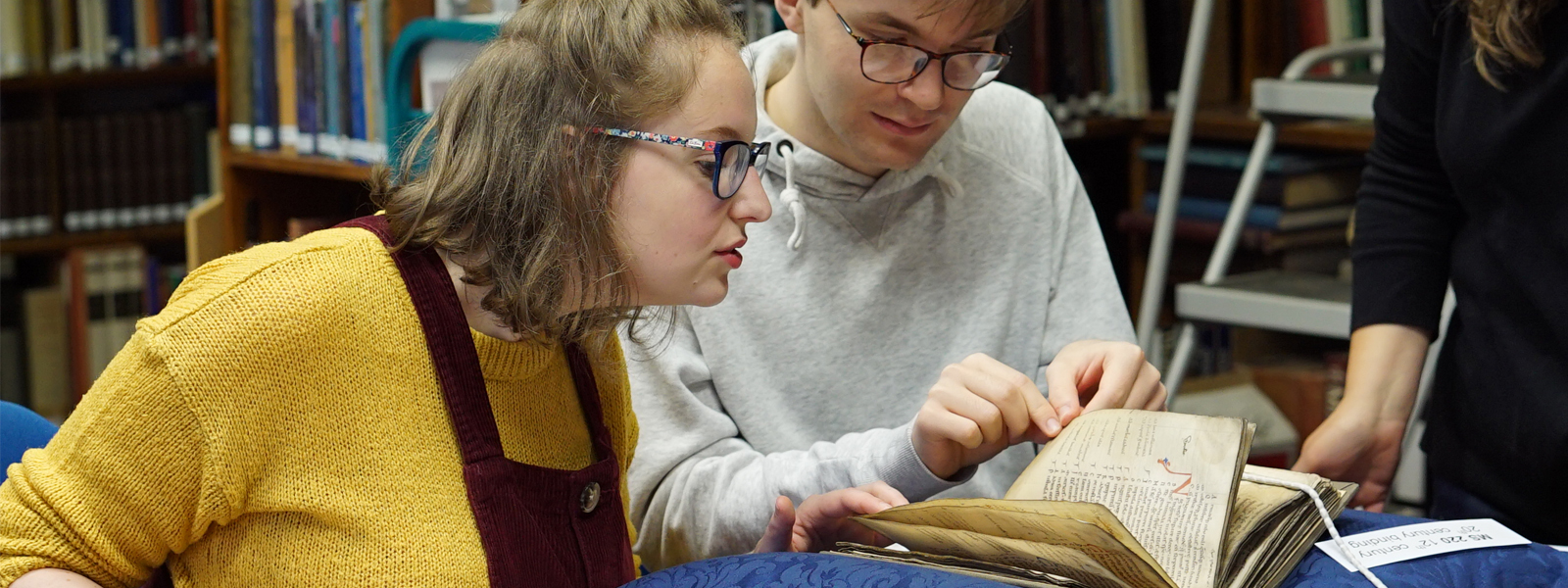
Experiential learning (especially working with manuscripts, rare books, local archives, and material objects, or developing skills in effective scholarly and non-academic communication) further enriches the academic experience for students on this course. A distinctive applied humanities ethos equips students with practical and transferable

skills essential for careers in publishing, heritage, education, digital curation, marketing, the arts, and the wider creative industries. Varied assessment types and module options promote academic skills and writing for/ speaking to varied audiences.

All students begin by studying ‘Contemporary Approaches to Literature’ (30 credits). This core module focuses on key themes related to the history and study of literature across different periods and geographies (structured in three-week themed “blocks”). It also builds the foundations of students’ engagement with recent critical developments in the discipline. Areas of focus may include global literature, health humanities, adaptation theory, gender and ageing, “banned books”, and reception studies – but the primary texts and “blocks” will change each year according to staff expertise. The module also embeds additional research skills and assessment support, to ensure a solid foundation of critical knowledge and to build confidence in evaluating literature across various modes of communication. Flexible assessments provide choice in not only topic or text, but also the format of the assignment.

Optional modules (listed below) include a wide period coverage from the Medieval period and Renaissance to the long nineteenth century and contemporary moment. Your choice of options, supported by flexible assessment topics and activities within modules, translates into a postgraduate experience uniquely tailored to you. The materials studied will range from familiar and canonical authors (such as Chaucer, Austen, Mary Shelley or Kazuo Ishiguro) to texts and writers that remain comparatively understudied. 

In my experience, the transition from Undergraduate to Postgraduate has been incredibly smooth. My postgraduate course was a comfortable next step into further study, and I’ve found the workload very manageable.

The elective modules give you the opportunity to study a topic or genre in greater depth than at BA, and to curate your focus according to your own interests. For example, you could decide to explore folk horror and monstrosity in ‘Gothic Spaces’, dive into feminist utopias on ‘Writing Utopia and Dystopia’, or reflect on issues of sustainability and ecological crisis in ‘Literature, Ecology and the Post-Human.’

Students fascinated by questions of literary history and legacy might choose to take the option module ‘The Nineteenth Century Novel’ or ‘Robin Hood and the Outlaw Tradition’. In ‘Reading the Archive’, you will learn how to engage critically with archival material – from illuminated manuscripts and Victorian ephemera to contemporary zines and work by famous Lincolnshire poet Alfred Tennyson. Through practical workshops using rich local collections or digital repositories, students taking ‘Reading the Archive’ will experience the benefits of archival study first-hand, and share their research in an MA Symposium. 

Why Choose Lincoln

Broad research expertise, from medieval to contemporary global literature

Develop professional skills to boost your employability

Flexible optional modules, including work placement opportunities

Choose between a Dissertation or Extended Editorial Project

Access unique archival resources and build digital research skills

Wednesday-only teaching to fit around other commitments

A student examining an historic text

How You Study

The PG Dip consists primarily of 2-hour seminars which run from 10am-12pm and 2pm-4pm. All scheduled teaching is conducted on Wednesdays to allow students to fulfil other commitments.

A series of Research Skills and Careers or Assessment Support sessions also run on Wednesdays, in conjunction with the core module Contemporary Approaches to Literature (Semester A) as well as Personal Tutor meetings. These sessions address potential career routes following completion of the programme and also provide a pathway to further study. Your dedicated personal tutor will remain a key point of contact for academic and pastoral matters during your studies, and will also support your career development plans.

Assessments on the course incorporate traditional essays and presentations, as well as providing opportunities to strengthen skills that transfer to the workplace, for example through developing lesson plans, archival catalogue entries, blog writing, or engaging in editorial practice. Many assessments have optional elements, which means that you can tailor your assessments according to your own interests and career development.

Lecturers bring different specialisms to their teaching, which is interesting and keeps us engaged with different perspectives.

Modules

Module Overview

This core module will introduce students to current critical, historiographical and theoretical debates in literary studies. It will enable students to engage with a diverse range of fictional and critical texts crucial to understand English Literature in the contemporary moment. The module also incorporates reflections about the role and value of the literature in the modern world. Students can explore how literature circulates, as well as consider how readers and authors shape literary interpretation or reception. The module provides a foundation for postgraduate literary study, and encourages students to consider how their knowledge can be translated to different audiences or professional settings.

Stretching from the Medieval period to the twenty-first century, the module will establish thematic and conceptual connections across literary time periods and develop lines of inquiry students may have already encountered at undergraduate level. It will address the relationship between concepts, themes and genres to establish how literary studies grapples with – and responds to – cultural and historical change.

Students will also engage with key critical approaches to literary and cultural theory to gain a deeper understanding of how scholarship informs readings of texts. They will undertake assessments and participate in workshops that develop skills critical to academic work and professional practice, exploring how English can be an ‘applied discipline’ with transferable skills. This module will strengthen students' understanding of recent trends in literary studies, as well as their appreciation of the uses of literary studies in relation to professional skills.

An introductory session on recent developments in the field of English literature will be followed by three-week ‘blocks’ on topics, genres and concepts such as: Adaptation and Reception Theory, Politics and Resistance, Banned Books, Literature and the Environment, England and Englishness, and Global Medical Humanities. The module will be taught by a team of academics with research specialisms in each three-week ‘block’.

Contemporary Approaches to Literature will run in Semester A as the single core module for the MA, PG Dip and PG Cert in order to prepare students for the standards required at PGT level. Skills workshops attached to the module will run across the semester, in separate timetabled sessions.

Module Overview

This module explores Gothic representations of haunted locations and environments which provoke, or symbolise, psychological and social disturbances.

Space has always had a central conceptual significance in the Gothic mode, which is dominated by haunted houses, desolate or extreme landscapes, and claustrophobic interiors, environments where safety and sanity are threatened. Gothic texts of all periods and cultural contexts use spatial tropes and metaphors to focalise themes of alienation, repression, monstrosity and mental fragmentation. They give form to the fear, violence and ideological contradictions that haunt the settings we would prefer to regard as familiar and homely.

The module considers a variety of texts (novels, short stories and films), from the Victorian era to the contemporary period. Settings typically range from urban and suburban locations to rural fringes, islands, mountains and wildernesses. Collectively, these texts dramatize anxieties centring on childhood, gender relations, urbanization, mental illness, the sublime, climate change, race, ethnicity and nationhood.

Module Overview

Since the Enlightenment, much human thought has assumed control of the non-human and has increasingly had only human interests in mind. The first principle of ecological and post-humanist thinking, however, is that other things exist beside humans, and that we are neither so separate from, nor so dominant over, the non-human as Christian and post-Christian Humanism has taught us to think. This module introduces students to key theoretical texts on ecology and post-humanism, and challenges them to reassess the anthropocentric ways of thinking that have brought us to our current ecological crisis and consequent focus on sustainability. Students will examine literature as an exploration and expression of our complex interaction with our environment, from the non-human to the inorganic. Their subject matter will be not just ‘nature writing’, but also texts in various forms and media, from the ancient to the contemporary, that look very different when viewed without Humanist presuppositions. Overall, this module familiarises students with developments in literary criticism in the late twentieth- and twenty-first centuries, asking them to reevaluate their own relationships with the surrounding world.

Module Overview

This module explores the important relationship between archival research and the study of literature. By focusing on the intersection between book history, material and visual cultures, and critical methodologies for literary study, the module frames the evaluation of texts through physical interactions with archival “stuff” from the medieval period to today. Students will explore multiple aspects of hand-on research in archives, using both local Lincolnshire collections (such as the Cathedral Libraries, Tennyson Research Centre, and/or Lincolnshire Archives) as well as university and onsite resources (such as Library Special Collections), staff or student personal collections, and digital repositories from farther afield.

The module complements traditional, theoretical modes of reading (which may focus on a text’s content and intellectual ideas) by investigating texts and other archival documents (such as manuscripts, textual marginalia, letters, photographs, various media, and ephemera) as physical objects. It foregrounds the retention, use and dissemination of material texts in libraries and collections (as well as where and how archival “gaps” may be instructive), and on how “things” saturate literature to facilitate new approaches to the discipline.

Students will develop a wide range of practical skills in the research, analysis, and presentation of historical and literary materials, including documents, books, and objects in collections. Students will be assessed by presenting on an archival text or object at an organised event (which students will help facilitate), and by writing an essay that reflects their skills and learning on the module.

Module Overview

Robin Hood is arguably one of the most notorious figures in history and literature; he has captured the imagination of countless writers, in the medieval period and beyond. Yet he is not the only outlaw of the medieval period. Other outlaws—some historical, some fictional, and some considerably more famous than others—preceded and even shaped what became the Robin Hood legends. This module introduces students to outlaws and outlawry as historical and literary constructs. Students will examine what the figure of the outlaw meant to the people of Britain in the Middle Ages, especially in the post-Conquest period, as well as how he was, and still is, connected to history and myth in literature. They will examine the glorification of crime associated with outlaw narratives and the resistance to primarily clerical and state authority they present; the underlying issues of friendship and loyalty; and other themes prevalent in outlaw legends, such as nature, human and animal relations, gender, religion, tricksters and trickery, class, warfare and weaponry. Finally, students will asses how outlawry and outlaw figures (especially Robin Hood) have been transmitted, as a type of ‘medievalism,’ to later periods and what the outlaw figure means in contemporary society. Overall, students will analyse and evaluate representations of outlaws in a range of media, from chronicles, ballads, and dramatic texts to children’s literature, film, and television.

Module Overview

In the nineteenth century, the novel reached maturity as a form and, arguably, its zenith. This module addresses some of the riches of fiction of this era in which we encounter the roots of our own modernity. Students explore how the novel articulated pressing social and philosophical concerns in the wake of radical cultural change and a newly empowered bourgeoisie.

Whether they present panoramas of community or focus on the trials and triumphs of a single protagonist, nineteenth-century novels explore the pains and pleasures of the individual attempting to find belonging in an often alienating environment.

While realism is the dominant mode, other generic influences include Gothic, naturalism, 'sensation' and satire. Longer works are studies alongside shorter novels and novellas. The module takes an international approach, including examples from North America as well as British classics, and potentially works (in translation) from non-anglophone settings including Russia and Europe.

Module Overview

Dreaming of a better life and a perfect world has been part of the human condition for all of human history, but utopian fiction as a separate and identifiable genre began in 1516 with the publication of More’s Utopia, the foundational utopian text. In this module we identify key features and characteristics of the literary utopia and trace the development of the genre from More through the nineteenth century and into the twentieth and twenty-first. Although dystopia is the dominant form up to the 1950s, a revival of (feminist) interest in utopianism, both as an aesthetic mode, and as political practice, arises in the 1960s and the utopian novel re-emerges in the form of the ‘critical utopia’. Twenty-first-century utopias will then form a focus for thinking about the significance of utopia and utopian writing today. We will explore the relationship between literary form and theories of utopianism, consider whether utopian/dystopian writing has become the principal vehicle for social and political critique in contemporary fiction, and discuss its relationship to the crisis of the Enlightenment project of modernity as well as the treatment of language and nature.

† Some courses may offer optional modules. The availability of optional modules may vary from year to year and will be subject to minimum student numbers being achieved. This means that the availability of specific optional modules cannot be guaranteed. Optional module selection may also be affected by staff availability.

What You Need to Know

We want you to have all the information you need to make an informed decision on where and what you want to study. In addition to the information provided on this course page, our What You Need to Know page offers explanations on key topics including programme validation/revalidation, additional costs, and contact hours.

Research Areas

The English department in the Lincoln School of Humanities and Heritage has particular strengths in twenty-first century literature, nineteenth-century literature, medieval(ism), children’s literature, American fiction, and global/indigenous literatures. Staff have published widely on women's writing (including life writing), politics, gothic film and fiction, age studies, travel writing and migration studies, religion, eco-criticism, and visual/material cultures. Recent research activities and publications by the English team can be found on our staff webpage.

Research Groups and Extracurricular Activities

Staff and postgraduate students are active in the dynamic research culture of the School of Humanities and Heritage (LSHH). Students can regularly attend Research Seminars organised by the Medieval and Early Modern Studies Research Group and the Nineteenth Century Research Cluster in the School, and are encouraged to participate in the activities of the Research Groups for Critical Heritage and Place Consumption, Creativity and Cultural Industries, or Global and Transregional Studies, according to their own interests. MA students have opportunities across the year to participate in social events with other postgraduates in the School and beyond, cementing their place in the welcoming, diverse community at the University of Lincoln.

Field Trips offer opportunities to visit arts institutions or attend events that connect literary studies and cultural heritage. Recent activities have involved students attending a Rare Book School at the University of Oxford, a visit to Lord Byron’s gothic home Newstead Abbey, a theatre trip to see Zadie Smith’s play The Wife of Willesden (a decolonial retelling of Chaucer’s tale about the Wife of Bath), and a hands-on workshop making cyanotype prints using Victorian technology. Visiting Speakers also enrich the student experience at Lincoln; guests have included Patience Agbabi, Carol Ann Duffy, Andrew Graham-Dixon, Celeste Mohammed, and Chris Packham. 

Facilities

You can study and research in the University's Great Central Warehouse Library, which provides more than 260,000 printed books and approximately 750,000 electronic books and journals, as well as databases and specialist collections. The Library has a range of different spaces for shared and individual learning. Some modules, such as ‘Reading the Archive’, may also involve taught sessions delivered off campus (e.g. in the Cathedral Library Special Collections or Tennyson Research Centre).

The Great Central Warehouse Library

How you are assessed

This programme features a range of familiar assessment methods including traditional essays (usually up to 5,000 words for a 30-credit module), and sharing research through presentations (both in person and pre-recorded).

In addition, this postgraduate course in English Literature recognises the demand for critical thinking and the expectations of effective communication skills valued by our graduates' future employers. This has informed a range new, innovative options for assessment that align with popular career pathways for English graduates (such as publishing, teaching/education, arts administration and cultural or heritage industries, and research or further study at PhD level). Students have opportunities for assessments comprising creative writing elements, preparing lesson plans, conducting editorial work, writing blogs for nonspecialists, or compiling archival catalogue notes. Several assignments allow students to select their own form of assessment from an indicative range.

How to Apply

Postgraduate Application Support

Applying for a postgraduate programme at Lincoln is easy. Find out more about the application process and what you'll need to complete on our How to Apply page. Here, you'll also be able to find out more about the entry requirements we accept and how to contact us for dedicated support during the process.

A student listening in a seminar

Entry Requirements 2026-27

Entry Requirements

The standard entry requirement for the programme is a 2:2 BA in English or a related subject. Alternative relevant qualifications (eg a PGCE) that highlight critical thinking, communication skills, or independent research skills may also be considered.

To assess your suitability for the programme, we adopt a holistic view of an applicant's academic and professional portfolio. Applicants who do not meet the standard academic criteria will still be considered if they have demonstrable relevant experience in sectors such as:

- Creative Industries (Writing, Editing, Publishing, Arts administration, Heritage sector volunteer-work)
- Journalism
- Teaching and Education
- Curating, Museums, or Archives
- Marketing and Communication

Applicants could also draw on extracurricular involvement in literary societies, creative writing groups, student publications, copywriting or literary/arts content creation in their application to demonstrate their suitability for the programme.

Following your application to the course, you may be invited to attend an online interview with one or more members of the English department.

If you have studied outside of the UK, and are unsure whether your qualification meets the above requirements, please visit our country pages: https://www.lincoln.ac.uk/studywithus/internationalstudents/entryrequirementsandyourcountry/ .

Overseas students will be required to demonstrate English language proficiency equivalent to IELTS 7.0 overall, with a minimum of 6.5 in each element. For information regarding other English language qualifications we accept, please visit the English Requirements page.

Please note application assessment criteria may vary by country and we may close to applications from some domiciles. Please view the Your Country pages of our website before making an application.

Course Fees

You will need to have funding in place for your studies before you arrive at the University. Our fees vary depending on the course, mode of study, and whether you are a UK or international student. You can view the breakdown of fees for this programme below.

Course Fees

The University offers a range of merit-based, subject-specific, and country-focused scholarships for UK and international students. To help support students from outside of the UK, we offer a number of international scholarships which range from £1,000 up to the value of 50 per cent of tuition fees. For full details and information about eligibility, visit our scholarships and bursaries pages.

Course-Specific Additional Costs

While some of our earlier core texts are available for free online, you will need to purchase copies of most of the primary texts that we discuss in seminars. It is usually possible to source these second-hand and fairly cheaply.

Funding Your Study

Postgraduate Funding Options

Find out more about the optional available to support your postgraduate study, from Master's Loans to scholarship opportunities. You can also find out more about how to pay your fees and access support from our helpful advisors.

Two students working on a laptop in a study space

Career Development

The English Literature PG Dip embeds employability across its provision, with many assessments providing flexibility that allows students to demonstrate these transferable skills. It is designed to develop strong communication and critical-thinking skills which can be transferable to a diverse range of careers. The programme aims to provide training for roles in teaching, research, publishing, journalism, and media. Students are able to develop skills in research, communication, writing, presentation, and independent learning. 

The University intends to provide its courses as outlined in these pages, although the University may make changes in accordance with the Student Admissions Terms and Conditions.