Skip to content

Concerned with the study of matter, its properties and reactions, chemistry plays a key role in tackling global challenges such as energy production, health and wellbeing, food security and the use of natural resources. The programme aims to develop the analytical and practical skills required to prepare students for a wide range of science-related careers.

The MChem Chemistry degree aims to integrate the core chemistry disciplines with advanced topics aligned to the major scientific challenges of the 21st Century. These include nanoscience for new materials and devices, the chemistry/biology interface for drugs discovery, nuclear chemistry for safe energy generation, biotechnology for new manufacturing methods, and sensors for forensic medical and environmental applications.

Students have the opportunity to engage with staff in research projects and this research-focused environment can enable students to develop practical expertise and apply theoretical knowledge to the role of chemistry in the modern world.

Concerned with the study of matter, its properties and reactions, chemistry plays a key role in tackling global challenges such as energy production, health and wellbeing, food security and the use of natural resources. The programme aims to develop the analytical and practical skills required to prepare students for a wide range of science-related careers.

The MChem Chemistry degree aims to integrate the core chemistry disciplines with advanced topics aligned to the major scientific challenges of the 21st Century. These include nanoscience for new materials and devices, the chemistry/biology interface for drugs discovery, nuclear chemistry for safe energy generation, biotechnology for new manufacturing methods, and sensors for forensic medical and environmental applications.

Students have the opportunity to engage with staff in research projects and this research-focused environment can enable students to develop practical expertise and apply theoretical knowledge to the role of chemistry in the modern world.

Why Choose Lincoln

Subject ranked 2nd in the UK for student satisfaction*

Full-year industrial placement

Accredited by the Royal Society of Chemistry

Industry challenges set through partnerships with multinational organisations

Focus on professional practice to improve career prospects

Engage with staff on research projects

*Complete University Guide 2025 (out of 48 ranking institutions)

YouTube video for

How You Study

The course includes lectures, seminars, laboratory-based practical classes and lectures from visiting scientists. Extensive small-group teaching and innovative team-based learning create a supportive learning environment that helps you train through practice- and problem-based approaches.

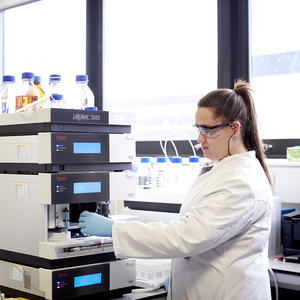
Students can focus initially on organic, inorganic, and physical chemistry through an integrated approach that emphasises connectivity. Laboratory workshops and extensive use of specialist equipment aims to enable students to develop hands-on skills. Later in the course, students have the opportunity to apply their experience to a range of real-world applications, including industry-informed interdisciplinary projects. A significant research project provides students with the chance to develop a specialism of their choice. Throughout the course, there is an emphasis on developing the professional skills required for students' future careers.

All students in the fourth year of the MChem programme currently have the opportunity to undertake a full-year industrial placement. You can choose your placement with one of the University's industry or overseas partners, or in one of our research groups. Placements are conducted alongside advanced academic study, focusing on research frontiers in chemistry.

Students are supported in finding their placement and when undertaking it. Salaried placements are competitive and students will be expected to complete an application process for such positions. In addition to paying their tuition fees, students will need to cover their own travel, accommodation, and general living costs throughout their placement.

How You Study

The course includes lectures, seminars, laboratory-based practical classes and lectures from visiting scientists. Extensive small-group teaching and innovative team-based learning create a supportive learning environment that helps you train through practice- and problem-based approaches.

Students can focus initially on organic, inorganic, and physical chemistry through an integrated approach that emphasises connectivity. Laboratory workshops and extensive use of specialist equipment aims to enable students to develop hands-on skills. Later in the course, students have the opportunity to apply their experience to a range of real-world applications, including industry-informed interdisciplinary projects. A significant research project provides students with the chance to develop a specialism of their choice. Throughout the course, there is an emphasis on developing the professional skills required for students' future careers.

All students in the fourth year of the MChem programme currently have the opportunity to undertake a full-year industrial placement. You can choose your placement with one of the University's industry or overseas partners, or in one of our research groups. Placements are conducted alongside advanced academic study, focusing on research frontiers in chemistry.

Students are supported in finding their placement and when undertaking it. Salaried placements are competitive and students will be expected to complete an application process for such positions. In addition to paying their tuition fees, students will need to cover their own travel, accommodation, and general living costs throughout their placement.

Modules

Module Overview

This module aims to provide a breadth core understanding of the main chemical principles behind the chemistry of elements, systems in equilibrium and chemical reactivity, with special emphasis in basic organic reactions.

Students will have the opportunity to learn basic concepts about elements and their main periodic properties and how some of these elements can be combined to produce molecules. Organic molecules will be used as an example to explain reactivity and how chemical structure can condition molecular properties. Energy transfers are also studied to understand the key role they play in chemical and physical transformations and how systems in equilibrium are affected by these.

Module Overview

This module aims to introduce core chemistry concepts with an emphasis on chemical change. Movement and interaction of molecules and chemical kinetics are key physical chemistry topics covered and applied to chemical reactions of both organic and inorganic substances. The use of empirical data to develop and support laws, theories and models will be covered and how chemical kinetics can be used to develop reaction mechanisms. An introduction to crystallography and absorption spectroscopy is covered.

Module Overview

This module builds upon foundational knowledge developed in Level 4 to expand students’ knowledge and understanding of chemical reactivity in molecular systems. Knowledge of physicochemical approaches to understanding and quantifying chemical change, via reaction kinetics, is advanced. It also offers insight into the fundamentals of transition metal complexes and their utility in homogeneous catalysis, and extends understanding of mechanism and reactivity of organic compounds.

Module Overview

The option to study overseas is a valuable educational opportunity for our students. Provision of this option supports the educational aims of the Chemistry programmes and enhances the distinctiveness of its degrees at Lincoln. The experience is intended to:

- enable students to benefit from studying within a cross cultural environment;

- expose students to a wider academic and cultural experience;

- enhance their future employment opportunities;

- by increasing their cultural and professional mobility.

This module is optional for students within the School. Study Abroad is a module which enables students to spend a year studying abroad at one of the University’s approved partner institutions. Eligible students must have completed their third year of study to a satisfactory standard and successfully completed the application process for the year abroad.

During the time spent abroad, students will complete the professional development portfolio and will critically reflect upon their experience of living and studying in a different cultural environment and the skills acquired.

Module Overview

This module develops a systematic understanding of how molecular shape, symmetry and stereochemistry govern bonding, properties and reactivity across the chemical sub‑disciplines. Students apply group theory and MO concepts to interpret character tables, predict selection rules, and rationalise bonding in polyatomic and cluster species; and they evaluate statistical thermodynamics (distributions, partition functions, ensembles) and read potential‑energy surfaces to relate microscopic behaviour to bulk properties and spontaneity.

Module Overview

This module aims to provide students skills to critically analyse and adopt topical areas of research and advance instrumentation in the field of chemistry. This information will be utilised to provide students with an understanding and appreciation of how fundamental chemistry theory and experimentation are being applied to contemporary cutting edge science. The module will reflect the current research focus within the School of Chemistry. Students learning will comprise a series of ‘short courses’ (consisting of lectures and workshops) in two key areas: Frontiers in Chemistry and Advanced Techniques. Typically students will be offered choices in each area and will assemble six short courses to include a minimum of three from Frontiers in Chemistry and three from Advanced Techniques.

The short courses will build on student’s knowledge of basic physical, organic and inorganic chemistry and will deliver in-depth coverage of its application in the main-stream chemical, biological and environmental processes.

Module Overview

This module aims to develop systematic personal and professional development of a student in a specialist area of chemistry to enhance employability. This is achieved through development and execution of a personal learning plan designed using a process of self-reflection around five development themes: personal development; professional skills development; technical skills development; research interests; career development.

Module Overview

This module provides students with the opportunity to apply chemical knowledge and laboratory skills to an extended practical research study. It also provides the opportunity to further develop professional skills, including the use of online literature/chemical data searching; ability to critically review relevant published literature & written/oral presentation of research activities.

Module Overview

This module provides students with opportunity to apply chemical knowledge & laboratory skills to an extended practical research study within a commercial context. Further develop professional skills incl. use of on-line literature/chemical data searching; ability to critically review relevant published literature & written/oral presentation of research activities


† Some courses may offer optional modules. The availability of optional modules may vary from year to year and will be subject to minimum student numbers being achieved. This means that the availability of specific optional modules cannot be guaranteed. Optional module selection may also be affected by staff availability.

Modules

Module Overview

This module aims to provide a breadth core understanding of the main chemical principles behind the chemistry of elements, systems in equilibrium and chemical reactivity, with special emphasis in basic organic reactions.

Students will have the opportunity to learn basic concepts about elements and their main periodic properties and how some of these elements can be combined to produce molecules. Organic molecules will be used as an example to explain reactivity and how chemical structure can condition molecular properties. Energy transfers are also studied to understand the key role they play in chemical and physical transformations and how systems in equilibrium are affected by these.

Module Overview

This module aims to introduce core chemistry concepts with an emphasis on chemical change. Movement and interaction of molecules and chemical kinetics are key physical chemistry topics covered and applied to chemical reactions of both organic and inorganic substances. The use of empirical data to develop and support laws, theories and models will be covered and how chemical kinetics can be used to develop reaction mechanisms. An introduction to crystallography and absorption spectroscopy is covered.

Module Overview

This module builds upon foundational knowledge developed in Level 4 to expand students’ knowledge and understanding of chemical reactivity in molecular systems. Knowledge of physicochemical approaches to understanding and quantifying chemical change, via reaction kinetics, is advanced. It also offers insight into the fundamentals of transition metal complexes and their utility in homogeneous catalysis, and extends understanding of mechanism and reactivity of organic compounds.

Module Overview

The option to study overseas is a valuable educational opportunity for our students. Provision of this option supports the educational aims of the Chemistry programmes and enhances the distinctiveness of its degrees at Lincoln. The experience is intended to:

- enable students to benefit from studying within a cross cultural environment;

- expose students to a wider academic and cultural experience;

- enhance their future employment opportunities;

- by increasing their cultural and professional mobility.

This module is optional for students within the School. Study Abroad is a module which enables students to spend a year studying abroad at one of the University’s approved partner institutions. Eligible students must have completed their third year of study to a satisfactory standard and successfully completed the application process for the year abroad.

During the time spent abroad, students will complete the professional development portfolio and will critically reflect upon their experience of living and studying in a different cultural environment and the skills acquired.

Module Overview

This module develops a systematic understanding of how molecular shape, symmetry and stereochemistry govern bonding, properties and reactivity across the chemical sub‑disciplines. Students apply group theory and MO concepts to interpret character tables, predict selection rules, and rationalise bonding in polyatomic and cluster species; and they evaluate statistical thermodynamics (distributions, partition functions, ensembles) and read potential‑energy surfaces to relate microscopic behaviour to bulk properties and spontaneity.

Module Overview

This module aims to provide students skills to critically analyse and adopt topical areas of research and advance instrumentation in the field of chemistry. This information will be utilised to provide students with an understanding and appreciation of how fundamental chemistry theory and experimentation are being applied to contemporary cutting edge science. The module will reflect the current research focus within the School of Chemistry. Students learning will comprise a series of ‘short courses’ (consisting of lectures and workshops) in two key areas: Frontiers in Chemistry and Advanced Techniques. Typically students will be offered choices in each area and will assemble six short courses to include a minimum of three from Frontiers in Chemistry and three from Advanced Techniques.

The short courses will build on student’s knowledge of basic physical, organic and inorganic chemistry and will deliver in-depth coverage of its application in the main-stream chemical, biological and environmental processes.

Module Overview

This module aims to develop systematic personal and professional development of a student in a specialist area of chemistry to enhance employability. This is achieved through development and execution of a personal learning plan designed using a process of self-reflection around five development themes: personal development; professional skills development; technical skills development; research interests; career development.

Module Overview

This module provides students with the opportunity to apply chemical knowledge and laboratory skills to an extended practical research study. It also provides the opportunity to further develop professional skills, including the use of online literature/chemical data searching; ability to critically review relevant published literature & written/oral presentation of research activities.

Module Overview

This module provides students with opportunity to apply chemical knowledge & laboratory skills to an extended practical research study within a commercial context. Further develop professional skills incl. use of on-line literature/chemical data searching; ability to critically review relevant published literature & written/oral presentation of research activities


† Some courses may offer optional modules. The availability of optional modules may vary from year to year and will be subject to minimum student numbers being achieved. This means that the availability of specific optional modules cannot be guaranteed. Optional module selection may also be affected by staff availability.

How you are assessed

The way students are assessed on this course may vary for each module. Examples of assessment methods that may be used include coursework, such as written assignments, reports, or dissertations; practical exams, such as presentations, performances, or observations; and written exams, such as formal examinations or in-class tests. The University of Lincoln's policy is to ensure that staff return assessments to students promptly.

How you are assessed

The way students are assessed on this course may vary for each module. Examples of assessment methods that may be used include coursework, such as written assignments, reports, or dissertations; practical exams, such as presentations, performances, or observations; and written exams, such as formal examinations or in-class tests. The University of Lincoln's policy is to ensure that staff return assessments to students promptly.

Accreditation

This course is accredited by the Royal Society of Chemistry. Through accreditation, the Royal Society of Chemistry aims to promote good practices in the university education of chemical scientists, and ensure that future practising scientists are knowledgeable and competent.

Royal Society of Chemistry Logo

Skills Development and Professional Practice

Our Chemistry courses have an embedded explicit skills development programme through the professional practice modules. The programme delivers a systematic programme in skills development, which includes CV writing and interview skills. The modules exemplify the application of chemistry into key employment sectors and present chemistry through an integrated approach.

Industry Challenges

A series of themed industry challenges are co-delivered during the professional practice modules through industry partnerships with multi-national and SME organisations representing the analytical, formulation, pharmaceutical, and energy and environmental sectors.

After systematic project planning and management training, students can devise and present technical proposals in response to the challenge. After consultation and feedback from a joint academic and industry panel, students can execute project plans and report within industry standard methods. The professional practice modules aim to prepare students for placements and future employment.

I felt my student experience was enhanced by the support available from both my peers and the staff, who were always ready and willing to help in any way they could.

Placements

We use an innovative ‘end-on’ full-year industrial placement programme for all students at Stage 4 of the MChem/MSci courses. You can choose to focus on research through a placement in a research group at the University or another institution, or complete a full-year placement (usually salaried £15-20k). Salaried placements are competitive and students will be expected to undertake an application process for such positions.

In addition to paying their tuition fees, students will need to cover their own travel, accommodation, and general living costs throughout their placement. There are also opportunities for overseas placements with European, American, and Australian institutions through our International Intern Programme which takes place between the third and fourth year.

What Can I Do with a Chemistry Degree?

Chemistry graduates may pursue a wide range of science-related careers in sectors including energy, petrochemicals, pharmaceuticals, and consumer and personal care products. This course aims to equip graduates with extensive analytical and mathematical skills which are relevant to roles in finance, management, science-based marketing and journalism, education, and academic research. Some graduates may choose to continue their studies at doctoral level.

Entry Requirements 2026-27

United Kingdom

112 to 120 UCAS Tariff points.

This must be achieved from a minimum of 2 A Levels or equivalent Level 3 qualifications, to include 40 points from Chemistry. For example:

A Level: BBC to BBB to include a Grade B in Biology or Chemistry

BTEC Extended Diploma in Applied Science accepted depending on modules: DDM

(Please include units on application)

T Level in Science: Merit Overall

(Health or Health Science not accepted)

Access to Higher Education Diploma: 112 to 120 UCAS points to be achieved from 45 Level 3 credits, including 40 points from 15 credits in Chemistry.

International Baccalaureate: 30 points overall to include a Higher Level 5 in Chemistry.

GCSE's: Minimum of three at grade 4 or above, which must include English, Maths and Science. Equivalent Level 2 qualifications may be considered.

The University accepts a wide range of qualifications as the basis for entry and do accept a combination of qualifications which may include A Levels, BTECs, Extended Project Qualification (EPQ).

We may also consider applicants with extensive and relevant work experience and will give special individual consideration to those who do not meet the standard entry qualifications.

International

Non UK Qualifications:

If you have studied outside of the UK, and are unsure whether your qualification meets the above requirements, please visit our country pages

https://www.lincoln.ac.uk/studywithus/internationalstudents/entryrequirementsandyourcountry/ for information on equivalent qualifications.

EU and Overseas students will be required to demonstrate English language proficiency equivalent to IELTS 6.0 overall, with a minimum of 5.5 in each element. For information regarding other English language qualifications we accept, please visit the English Requirements page

https://www.lincoln.ac.uk/studywithus/internationalstudents/englishlanguagerequirementsandsupport/englishlanguagerequirements/

If you do not meet the above IELTS requirements, you may be able to take part in one of our Pre-sessional English and Academic Study Skills courses.

https://www.lincoln.ac.uk/studywithus/internationalstudents/englishlanguagerequirementsandsupport/pre-sessionalenglishandacademicstudyskills/


For applicants who do not meet our standard entry requirements, our Science Foundation Year can provide an alternative route of entry onto our full degree programmes:
https://www.lincoln.ac.uk/course/sfysfyub/lifesciences/

If you would like further information about entry requirements, or would like to discuss whether the qualifications you are currently studying are acceptable, please contact the Admissions team on 01522 886097, or email admissions@lincoln.ac.uk

Contextual Offers

At Lincoln, we recognise that not everybody has had the same advice and support to help them get to higher education. Contextual offers are one of the ways we remove the barriers to higher education, ensuring that we have fair access for all students regardless of background and personal experiences. For more information, including eligibility criteria, visit our Offer Guide pages. If you are applying to a course that has any subject specific requirements, these will still need to be achieved as part of the standard entry criteria.

Entry Requirements 2027-28

United Kingdom

112 to 120 UCAS Tariff points from a minimum of 2 A Levels or equivalent Level 3 qualifications, to include 40 points from Chemistry.

If you are eligible for a contextual offer, a one grade or 8 UCAS Tariff point reduction to the standard entry requirements will be applied. Subject specific requirements will still be required as part of the standard entry criteria.

A Level: BBB to include a Grade B in Biology or Chemistry

BTEC Extended Diploma in Applied Science accepted depending on modules: DDM
(Please include units on application)

We will accept a Pearson Level 3 Alternative Academic Qualification BTEC National (equivalent to 1 A Level) in Medical Science or Applied Science to meet the subject specific requirement: Merit

T Level: Not currently accepted.

Access to Higher Education Diploma: 120 UCAS points to be achieved from 45 Level 3 credits, including 40 points from 15 credits in Chemistry.

International Baccalaureate: 30 points overall to include a Higher Level 5 in Chemistry.

GCSEs: Minimum of three at grade 4 or above, which must include English, Maths and Science. Equivalent Level 2 qualifications may be considered.

The University accepts a wide range of qualifications as the basis for entry and do accept a combination of qualifications which may include A Levels, BTECs, Extended Project Qualification (EPQ).

We may also consider applicants with extensive and relevant work experience and will give special individual consideration to those who do not meet the standard entry qualifications.
___________________________________________________

Non UK Qualifications:

If you have studied outside of the UK, and are unsure whether your qualification meets the above requirements, please visit our country pages

https://www.lincoln.ac.uk/studywithus/internationalstudents/entryrequirementsandyourcountry/ for information on equivalent qualifications.

EU and Overseas students will be required to demonstrate English language proficiency equivalent to IELTS 6.0 overall, with a minimum of 5.5 in each element. For information regarding other English language qualifications we accept, please visit the English Requirements page

https://www.lincoln.ac.uk/studywithus/internationalstudents/englishlanguagerequirementsandsupport/englishlanguagerequirements/

If you do not meet the above IELTS requirements, you may be able to take part in one of our Pre-sessional English and Academic Study Skills courses.

https://www.lincoln.ac.uk/studywithus/internationalstudents/englishlanguagerequirementsandsupport/pre-sessionalenglishandacademicstudyskills/

International


For applicants who do not meet our standard entry requirements, our Science Foundation Year can provide an alternative route of entry onto our full degree programmes:
https://www.lincoln.ac.uk/course/sfysfyub/lifesciences/

If you would like further information about entry requirements, or would like to discuss whether the qualifications you are currently studying are acceptable, please contact the Admissions team on 01522 886097, or email admissions@lincoln.ac.uk

Contextual Offers

At Lincoln, we recognise that not everybody has had the same advice and support to help them get to higher education. Contextual offers are one of the ways we remove the barriers to higher education, ensuring that we have fair access for all students regardless of background and personal experiences. For more information, including eligibility criteria, visit our Offer Guide pages. If you are applying to a course that has any subject specific requirements, these will still need to be achieved as part of the standard entry criteria.

Fees and Funding

University Study is a major investment, so it’s important to understand the costs and support available. A full breakdown of the fees associated with this programme can be found below. Eligible students may be able to access scholarships and bursaries to help with study costs.

Course Fees

Fees and Funding

University Study is a major investment, so it’s important to understand the costs and support available. A full breakdown of the fees associated with this programme can be found below. Eligible students may be able to access scholarships and bursaries to help with study costs.

Course Fees

Find out More by Visiting Us

The best way to find out what it is really like to live and learn at Lincoln is to visit us in person. We offer a range of opportunities across the year to help you to get a real feel for what it might be like to study here.

Three students walking together on campus in the sunshine

What You Need to Know

We want you to have all the information you need to make an informed decision on where and what you want to study. In addition to the information provided on this course page, our What You Need to Know page offers explanations on key topics including programme validation/revalidation, additional costs, and contact hours.

What You Need to Know

We want you to have all the information you need to make an informed decision on where and what you want to study. In addition to the information provided on this course page, our What You Need to Know page offers explanations on key topics including programme validation/revalidation, additional costs, and contact hours.

The University intends to provide its courses as outlined in these pages, although the University may make changes in accordance with the Student Admissions Terms and Conditions.