Skip to content

Clearing offers from 48 UCAS tariff points. Subject-specific requirements still apply. See the entry requirements section for details.

Design technology that powers the future.

Electrical and electronic engineering is behind many of the systems people rely on every day. From renewable energy and robotics, to smart devices, communications, transport, and automation.

On this course, you'll learn how electrical and electronic systems are designed, controlled, and connected, plus how engineers solve real-world problems using technology.

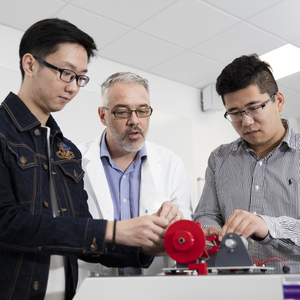
At Lincoln, you will apply the theory you learn through practical projects, laboratory work, design challenges, and industry-focused practice. You'll build technical skills in electronics, power systems, automation, and embedded systems, while also developing the problem-solving, teamwork, and analytical skills employers value.

Whether you already know you want to become an engineer, or are still exploring your options, this course is designed to give you broad career opportunities and practical experience.

Electrical and electronic engineering is behind many of the systems people rely on every day. From renewable energy and robotics, to smart devices, communications, transport, and automation.

On this course, you'll learn how electrical and electronic systems are designed, controlled, and connected, plus how engineers solve real-world problems using technology.

At Lincoln, you will apply the theory you learn through practical projects, laboratory work, design challenges, and industry-focused practice. You'll build technical skills in electronics, power systems, automation, and embedded systems, while also developing the problem-solving, teamwork, and analytical skills employers value.

Whether you already know you want to become an engineer, or are still exploring your options, this course is designed to give you broad career opportunities and practical experience.

I have been supported in developing my professional skills to be on track for becoming a Chartered Engineer, and I have made the most of what the course has to offer to help me build confidence in my own academic ability. The academic staff are supportive and I know they want to help me achieve to the best of my ability.

Why study Electrical and Electronic Engineering at Lincoln?

  • Industry-informed learning
    The School of Engineering was developed in collaboration with Siemens, helping shape teaching around real industry needs.
  • Learn through practical projects
    Apply your knowledge through lab work, engineering design, simulations, and hands-on problem-solving.
  • Study future-focused technologies
    Explore areas such as electrical power systems, renewable energy integration, communication systems, and smart electronics.
  • Accredited degree
    This course is accredited by the Institution of Engineering and Technology (IET), supporting progression towards Chartered Engineer status.
  • Strong employability focus
    Develop technical and transferable skills that prepare you for careers across multiple engineering sectors.
  • Specialist laboratories and equipment
    Lincoln has a range of specialist laboratories and equipment: an electrical systems laboratory including a high voltage test facility, EMC chamber, communications laboratory, computer labs, and purpose-built engineering workshops.

What you'll learn

This course builds your knowledge step by step, from engineering fundamentals to advanced electrical and electronic systems.

You'll explore:

  • Electrical circuits and power systems
  • Electronics and embedded systems
  • Control and communication systems
  • Engineering mathematics and modelling
  • Design, testing, and simulation

You’ll also develop skills in:

  • Problem-solving
  • Data analysis
  • Teamwork and project management
  • Technical communication

In your final year, you'll complete an independent engineering project, allowing you to specialise in an area that interests you, and showcase the skills you've developed throughout the course.

Assessment methods on the Electrical and Electronic Engineering programme aims to test engineering technical and analytical skills, as well as professional soft skills including oral and written communication, team working, long-life learning, problem-solving, project management, and planning and organisation.

The way students are assessed on this course may vary for each module. Examples of assessment methods that are used include time constrained assessments (TCAs), coursework, such as written assignments, reports, or dissertations; practical exams, such as presentations, performances, or observations; and written exams, such as formal examinations or in-class tests. The weighting given to each assessment method may vary across each academic year.

Modules

Module Overview

Many sectors of engineering require high levels of computer literacy and the ability to write computer programs for problem solving is highly desirable. In learning the fundamentals of computer programming, logical thinking and problem solving, skills can be developed and coding techniques learnt, that can support the study of modules in forthcoming years.

This course delivers the concepts of structured computer programming and lab time is allocated for implementing these concepts. Students are provided with opportunities to plan, write, and debug their own computer programs.

Module Overview

All engineers must be familiar with design strategies, methods of assessing design proposals, approaches to reducing uncertainty, formal communication techniques, and the industrial and legal standards in which they fit. Mechanical Engineering students can independently learn and demonstrate the fundamentals of mechanical technical drawing and computer aided design (CAD), while Electrical Engineering students will independently learn and demonstrate the fundamentals of electrical drawing and CAD.

Electrical and Mechanical engineers will then coalesce to form interdisciplinary groups who will produce an electro-mechanical design solution which meets a practical objective and considers the commercial, economic, social and environmental implications via a broad critique of the state of the art.

Module Overview

An understanding of the basic principles and many of the important practical applications of electronic and electrical engineering is now essential to practitioners of other disciplines, especially mechanical engineers.

The aim of this module is to provide a foundation in electrical engineering and electronics without being over complicated or cluttered with too-rigorous and exhaustive mathematical elements.

Module Overview

The module can be divided into two topics:

Statics and Mechanics:

The primary aim of the study of engineering mechanics is to develop students' capacity to predict the effects of force and deformation in the course of carrying out the creative design function of engineering. As students' undertake the study of solids and forces (first statics, mechanics, then dynamics) they can build a foundation of analytical capability for the solution of a great variety of engineering problems. Modern engineering practice demands a high level of analytical capability, and the study of mechanics can help in developing this.

Dynamics:

The study of dynamics gives students the opportunity to analyse and predict the motion of particles and bodies with and without reference to the forces that cause this motion. Successful prediction requires the ability of visualise physical configurations in terms of real machines ( in addition to knowledge of physical and mathematical principles of mechanics) and actual constraints and the practical limitations which govern the behaviour of machines.

Module Overview

The selection of materials and manufacturing method is an integral part of the engineering design procedure. The purpose of this module is to introduce the fundamental properties of engineering materials through an understanding of the atomic and molecular interactions within the material. Students are introduced to the technology of manufacturing processes and how the selection of manufacturing processes are influenced by, and subsequently affect, material properties.

Module Overview

A good mathematical grounding is essential for all engineers. The theory developed in this module aims to underpin the other engineering modules studied at level one. Wherever possible, mathematical theory is taught by considering a real example, to present students the mathematical tools they might need for the science they follow. Solutions are considered by both analytical and numerical techniques.

Module Overview

The syllabus for this module can be divided into two topics:

Thermodynamics:

Thermodynamics is an essential part of engineering curricula all over the world. It is a basic science that deals with energy interactions in physical systems, and the purpose of this module is to study the relationships between heat (thermos) and work (dynamics). This module presents a range of real-world engineering applications to give students a feel for engineering practice and an intuitive understanding of the subject matter.

Fluid Mechanics:

Fluid Mechanics is the branch of applied mechanics that is concerned with the statics and dynamics of liquids and gases. The analysis of the behaviour of fluids is based upon the fundamental laws of applied mechanics, which relate to the conservation of mass-energy and the force-momentum equation. However, instead of dealing with the behaviour of individual bodies of known mass, Fluid Mechanics is concerned with the behaviour of a continuous stream of fluid. For this reason, Fluid Mechanics is studied separately to other mechanics modules. Due to the similarity of the mathematical techniques, Fluid Mechanics are studied with Thermodynamics.

Module Overview

The aim of this module is to provide students with a firm grounding in Classical Control methods, which will enable them to work with systems and control engineers, and prepare students on the control stream for advanced topics in the level three and four modules.

Students will be introduced to Control in relation to engineering systems, and in particular to develop methods of modelling the control of processes. Techniques are explored with particular reference to common practical engineering problems and their solutions, and the application of SIMULINK in this process.

Module Overview

The purpose of this programme of mathematical study is to give students the opportunity to become more competent in calculations using a range of mathematical tools. The content builds upon that delivered in the first year, and gives students the opportunity to extend their analytical skills by introducing more advanced topics that may form part of the modern engineers skill set.

Module Overview

This modules introduces the basic knowledge required to understand, design, and work with basic electronic circuits and the basic principles underlying the process of electronic engineering. No previous electronics experience is assumed and the module proceeds via a sequence of lectures supported by labs designed to introduce practical electronics.

Module Overview

Students will be introduced to electrical machines and power systems and their practical applications, supported by practical analysis/synthesis methods.

This ability is fundamental for the students with mechanical engineering background, if they are to be able to handle electromechanical problems encountered in real life situations.

Students will further have the opportunity to explore a general methodology for the calculation of electromechanical energy conversion. Students can obtain an appreciation of the features and characteristics of different types of electromechanical machines and drives and their applications.

Module Overview

This module aims to provide an introduction to the subject of industrial engineering.

Industrial engineering is a branch of engineering dealing with the optimisation of complex processes or systems. It is concerned with the development, improvement, implementation and evaluation of integrated systems of people, economic resources, knowledge, information, equipment, energy, materials, analysis and synthesis, as well as the mathematical, physical and social sciences together with the principles and methods of engineering design to specify, predict, and evaluate the results to be obtained from such systems or processes. The various topics include management science, cost and value engineering, business economics and finance, engineering management, supply chain management, operations research, health and safety engineering, operation management.

Module Overview

The aim of this module is to deepen students’ understanding of engineering in practical applications. Students will investigate the design process for mechanical, electrical or control components/systems and undertake analysis of the same.

These strands of the module are brought together in a design challenge, which will address real-world challenges facing industry. This will allow students to apply and extend their creative design skills and obtain practical experience of creating sound conceptual solutions to address real design problems within an industrial context.

Module Overview

The term mechatronics integrates mechanical engineering with electronics and intelligent computer control in the design and manufacture of products and processes. As a result, many products which used to have mechanical functions have had many replaced with ones involving microprocessors. This has resulted in much flexibility, easier redesign and reprogramming, and the ability to carry out automated data collection and reporting. A consequence of this approach is the need for engineers to adopt an interdisciplinary and integrated approach to engineering.

The overall aim of this module is to give a comprehensive coverage of topics, such as analogue and digital signals, digital logic, sensors and signal conditioning, data acquisition systems, data presentation systems, mechanical and electrical actuation systems, microcontroller programming and interfacing, system response and modelling, and feedback control. Students may make extensive use of Simulink and a MATLAB support packages based an Arduino board, which allow for graphical simulation and programming of real-time control systems. The module serves as an introductory course to more advanced courses such as Measurement and Testing, Sensors, Actuators and Controllers, and Embedded Systems.

Module Overview

Students with an understanding of the physics underlying semiconductor devices and applications will be given the opportunity to study the processing of semiconductors to produce devices. Students will also establish an understanding of electrostatics, electromagnetics, and electroconductive fields and a revision of wave propagation and electromagnetic plane waves in free space and wave polarisation is covered. Relation between component size and EM wavelength such as qualitative introduction to antennas , circuit interference effects at high frequencies as well as skin effect.

Module Overview

The Placement Year constitutes a work placement during an academic year, typically between Levels 2 and Level 3, though it may take place between levels 3 and 4 of an MEng programme. Students wishing to undertake the work placement year must successfully complete Level 2 (and 3 if applicable) of their programme.

The Placement Year aims to give students a continuous experience of full-time work within an organisation. It should be a three-way co-operative activity between employer, student, and University. Work placements enable students to experience at first hand the daily workings of an organisation while setting that experience in the broader context of their studies.

Module Overview

This module provides an opportunity for students in the School of Engineering and Physical Sciences to spend a year abroad at one of the University’s partner institutions. During the year abroad, students share classes with students at their chosen destination and study on a suite of locally delivered modules. This module will extend the length of your programme by one year and is taken between level 5 (year 2) and level 6 (year 3).

Module Overview

The module aims to enable students to gain knowledge and understanding of the principles and other key elements in communication systems and the theory involved in their design.

Students are introduced to analogue and digital communication systems, as well as to the use of information theory in the framework of communication systems and their performance. An important aspect of this module is studying the topics of random processes and noise, sampling and quantization, and introducing students to key issues of filter design and modulation. Laboratory work will be carried out in Matlab/Simulink or equivalent software tool.

Module Overview

The individual project aims to provide students with a learning experience that enables them to carry out independent research, and to integrate many of the subjects they have studied throughout their degree. Students are expected to plan, research and execute their task while developing skills in critical judgement, independent work and engineering competence. Students have the opportunity to gain experience in presenting and reporting a major piece of engineering work, of immediate engineering value, at a level appropriate for an honours degree student.

Module Overview

This module is intended to introduce students with the fast growing area of consumer electronics design.

Apart from interface and size issues, portable consumer electronics present some of the toughest design and engineering challenges in all of technology. This module breaks the complex design process down into its component parts, detailing every crucial issue from interface design to chip packaging, focusing upon the key design parameters of convenience, utility and size.

Module Overview

The aim of this module is to provide students with a thorough understanding of power electronics and electrical drives.

The first part of the module begins with an overview of the main concepts behind electrical power processing and control. Power semiconductor switches are then introduced and their use as basic components in power electronics systems is deeply investigated. Subsequently, the main power converters architectures are defined and systematically analysed. The second part of the module aims to enable students to gain knowledge and understanding of classical electric machines and drives.

Module Overview

In this module students will have the opportunity to work on the design of digital projects using Verilog for FPGA and ASIC implementation. Hierarchy of design abstraction and the process of top down design will also be covered, in addition to advanced concepts and methods of Verilog.

Investigation of FPGA architectures issues involved in FPGA based implementations of advanced digital designs are illustrated by practical laboratories and assignments.

Module Overview

The first aim of this module is to identify the major components of electrical power systems together with their characteristics. The second is to analyse the performance of power systems where these components act together. In addition, students will examine the methods and issues surrounding transmission of electrical power, including insight and understanding of power system protection and the effects of system design on power quality.


† Some courses may offer optional modules. The availability of optional modules may vary from year to year and will be subject to minimum student numbers being achieved. This means that the availability of specific optional modules cannot be guaranteed. Optional module selection may also be affected by staff availability.

Modules

Module Overview

Many sectors of engineering require high levels of computer literacy and the ability to write computer programs for problem solving is highly desirable. In learning the fundamentals of computer programming, logical thinking and problem solving, skills can be developed and coding techniques learnt, that can support the study of modules in forthcoming years.

This course delivers the concepts of structured computer programming and lab time is allocated for implementing these concepts. Students are provided with opportunities to plan, write, and debug their own computer programs.

Module Overview

All engineers must be familiar with design strategies, methods of assessing design proposals, approaches to reducing uncertainty, formal communication techniques, and the industrial and legal standards in which they fit. Mechanical Engineering students can independently learn and demonstrate the fundamentals of mechanical technical drawing and computer aided design (CAD), while Electrical Engineering students will independently learn and demonstrate the fundamentals of electrical drawing and CAD.

Electrical and Mechanical engineers will then coalesce to form interdisciplinary groups who will produce an electro-mechanical design solution which meets a practical objective and considers the commercial, economic, social and environmental implications via a broad critique of the state of the art.

Module Overview

An understanding of the basic principles and many of the important practical applications of electronic and electrical engineering is now essential to practitioners of other disciplines, especially mechanical engineers.

The aim of this module is to provide a foundation in electrical engineering and electronics without being over complicated or cluttered with too-rigorous and exhaustive mathematical elements.

Module Overview

The module can be divided into two topics:

Statics and Mechanics:

The primary aim of the study of engineering mechanics is to develop students' capacity to predict the effects of force and deformation in the course of carrying out the creative design function of engineering. As students' undertake the study of solids and forces (first statics, mechanics, then dynamics) they can build a foundation of analytical capability for the solution of a great variety of engineering problems. Modern engineering practice demands a high level of analytical capability, and the study of mechanics can help in developing this.

Dynamics:

The study of dynamics gives students the opportunity to analyse and predict the motion of particles and bodies with and without reference to the forces that cause this motion. Successful prediction requires the ability of visualise physical configurations in terms of real machines ( in addition to knowledge of physical and mathematical principles of mechanics) and actual constraints and the practical limitations which govern the behaviour of machines.

Module Overview

The selection of materials and manufacturing method is an integral part of the engineering design procedure. The purpose of this module is to introduce the fundamental properties of engineering materials through an understanding of the atomic and molecular interactions within the material. Students are introduced to the technology of manufacturing processes and how the selection of manufacturing processes are influenced by, and subsequently affect, material properties.

Module Overview

A good mathematical grounding is essential for all engineers. The theory developed in this module aims to underpin the other engineering modules studied at level one. Wherever possible, mathematical theory is taught by considering a real example, to present students the mathematical tools they might need for the science they follow. Solutions are considered by both analytical and numerical techniques.

Module Overview

The syllabus for this module can be divided into two topics:

Thermodynamics:

Thermodynamics is an essential part of engineering curricula all over the world. It is a basic science that deals with energy interactions in physical systems, and the purpose of this module is to study the relationships between heat (thermos) and work (dynamics). This module presents a range of real-world engineering applications to give students a feel for engineering practice and an intuitive understanding of the subject matter.

Fluid Mechanics:

Fluid Mechanics is the branch of applied mechanics that is concerned with the statics and dynamics of liquids and gases. The analysis of the behaviour of fluids is based upon the fundamental laws of applied mechanics, which relate to the conservation of mass-energy and the force-momentum equation. However, instead of dealing with the behaviour of individual bodies of known mass, Fluid Mechanics is concerned with the behaviour of a continuous stream of fluid. For this reason, Fluid Mechanics is studied separately to other mechanics modules. Due to the similarity of the mathematical techniques, Fluid Mechanics are studied with Thermodynamics.

Module Overview

The aim of this module is to provide students with a firm grounding in Classical Control methods, which will enable them to work with systems and control engineers, and prepare students on the control stream for advanced topics in the level three and four modules.

Students will be introduced to Control in relation to engineering systems, and in particular to develop methods of modelling the control of processes. Techniques are explored with particular reference to common practical engineering problems and their solutions, and the application of SIMULINK in this process.

Module Overview

The purpose of this programme of mathematical study is to give students the opportunity to become more competent in calculations using a range of mathematical tools. The content builds upon that delivered in the first year, and gives students the opportunity to extend their analytical skills by introducing more advanced topics that may form part of the modern engineers skill set.

Module Overview

This modules introduces the basic knowledge required to understand, design, and work with basic electronic circuits and the basic principles underlying the process of electronic engineering. No previous electronics experience is assumed and the module proceeds via a sequence of lectures supported by labs designed to introduce practical electronics.

Module Overview

Students will be introduced to electrical machines and power systems and their practical applications, supported by practical analysis/synthesis methods.

This ability is fundamental for the students with mechanical engineering background, if they are to be able to handle electromechanical problems encountered in real life situations.

Students will further have the opportunity to explore a general methodology for the calculation of electromechanical energy conversion. Students can obtain an appreciation of the features and characteristics of different types of electromechanical machines and drives and their applications.

Module Overview

This module aims to provide an introduction to the subject of industrial engineering.

Industrial engineering is a branch of engineering dealing with the optimisation of complex processes or systems. It is concerned with the development, improvement, implementation and evaluation of integrated systems of people, economic resources, knowledge, information, equipment, energy, materials, analysis and synthesis, as well as the mathematical, physical and social sciences together with the principles and methods of engineering design to specify, predict, and evaluate the results to be obtained from such systems or processes. The various topics include management science, cost and value engineering, business economics and finance, engineering management, supply chain management, operations research, health and safety engineering, operation management.

Module Overview

The aim of this module is to deepen students’ understanding of engineering in practical applications. Students will investigate the design process for mechanical, electrical or control components/systems and undertake analysis of the same.

These strands of the module are brought together in a design challenge, which will address real-world challenges facing industry. This will allow students to apply and extend their creative design skills and obtain practical experience of creating sound conceptual solutions to address real design problems within an industrial context.

Module Overview

The term mechatronics integrates mechanical engineering with electronics and intelligent computer control in the design and manufacture of products and processes. As a result, many products which used to have mechanical functions have had many replaced with ones involving microprocessors. This has resulted in much flexibility, easier redesign and reprogramming, and the ability to carry out automated data collection and reporting. A consequence of this approach is the need for engineers to adopt an interdisciplinary and integrated approach to engineering.

The overall aim of this module is to give a comprehensive coverage of topics, such as analogue and digital signals, digital logic, sensors and signal conditioning, data acquisition systems, data presentation systems, mechanical and electrical actuation systems, microcontroller programming and interfacing, system response and modelling, and feedback control. Students may make extensive use of Simulink and a MATLAB support packages based an Arduino board, which allow for graphical simulation and programming of real-time control systems. The module serves as an introductory course to more advanced courses such as Measurement and Testing, Sensors, Actuators and Controllers, and Embedded Systems.

Module Overview

Students with an understanding of the physics underlying semiconductor devices and applications will be given the opportunity to study the processing of semiconductors to produce devices. Students will also establish an understanding of electrostatics, electromagnetics, and electroconductive fields and a revision of wave propagation and electromagnetic plane waves in free space and wave polarisation is covered. Relation between component size and EM wavelength such as qualitative introduction to antennas , circuit interference effects at high frequencies as well as skin effect.

Module Overview

The Placement Year constitutes a work placement during an academic year, typically between Levels 2 and Level 3, though it may take place between levels 3 and 4 of an MEng programme. Students wishing to undertake the work placement year must successfully complete Level 2 (and 3 if applicable) of their programme.

The Placement Year aims to give students a continuous experience of full-time work within an organisation. It should be a three-way co-operative activity between employer, student, and University. Work placements enable students to experience at first hand the daily workings of an organisation while setting that experience in the broader context of their studies.

Module Overview

This module provides an opportunity for students in the School of Engineering and Physical Sciences to spend a year abroad at one of the University’s partner institutions. During the year abroad, students share classes with students at their chosen destination and study on a suite of locally delivered modules. This module will extend the length of your programme by one year and is taken between level 5 (year 2) and level 6 (year 3).

Module Overview

The module aims to enable students to gain knowledge and understanding of the principles and other key elements in communication systems and the theory involved in their design.

Students are introduced to analogue and digital communication systems, as well as to the use of information theory in the framework of communication systems and their performance. An important aspect of this module is studying the topics of random processes and noise, sampling and quantization, and introducing students to key issues of filter design and modulation. Laboratory work will be carried out in Matlab/Simulink or equivalent software tool.

Module Overview

The individual project aims to provide students with a learning experience that enables them to carry out independent research, and to integrate many of the subjects they have studied throughout their degree. Students are expected to plan, research and execute their task while developing skills in critical judgement, independent work and engineering competence. Students have the opportunity to gain experience in presenting and reporting a major piece of engineering work, of immediate engineering value, at a level appropriate for an honours degree student.

Module Overview

This module is intended to introduce students with the fast growing area of consumer electronics design.

Apart from interface and size issues, portable consumer electronics present some of the toughest design and engineering challenges in all of technology. This module breaks the complex design process down into its component parts, detailing every crucial issue from interface design to chip packaging, focusing upon the key design parameters of convenience, utility and size.

Module Overview

The aim of this module is to provide students with a thorough understanding of power electronics and electrical drives.

The first part of the module begins with an overview of the main concepts behind electrical power processing and control. Power semiconductor switches are then introduced and their use as basic components in power electronics systems is deeply investigated. Subsequently, the main power converters architectures are defined and systematically analysed. The second part of the module aims to enable students to gain knowledge and understanding of classical electric machines and drives.

Module Overview

In this module students will have the opportunity to work on the design of digital projects using Verilog for FPGA and ASIC implementation. Hierarchy of design abstraction and the process of top down design will also be covered, in addition to advanced concepts and methods of Verilog.

Investigation of FPGA architectures issues involved in FPGA based implementations of advanced digital designs are illustrated by practical laboratories and assignments.

Module Overview

The first aim of this module is to identify the major components of electrical power systems together with their characteristics. The second is to analyse the performance of power systems where these components act together. In addition, students will examine the methods and issues surrounding transmission of electrical power, including insight and understanding of power system protection and the effects of system design on power quality.


† Some courses may offer optional modules. The availability of optional modules may vary from year to year and will be subject to minimum student numbers being achieved. This means that the availability of specific optional modules cannot be guaranteed. Optional module selection may also be affected by staff availability.

Support and student experience

Starting university can feel like a big step, especially on a technical course. Support is available throughout your studies.

  • Personal tutor support - guidance throughout your degree
  • Academic skills support - help with maths, research, and technical writing
  • Careers guidance - CV support, placements, and interview preparation
  • Wellbeing services - confidential support when needed

You'll be supported as you develop both academically and professionally.

Accreditation*

*Pending re-accreditation for 2025

This degree is accredited by the Institution of Engineering and Technology (IET), to enable students completing the programme the eventual opportunity to register as a Chartered Engineer (CEng). Further Master's-level accredited learning is required to complete the educational base for full CEng status.

IET Accredited Programme

Placements

Gain hands-on experience in a real workplace and apply your learned skills in a professional setting.

  • Develop practical skills and professional confidence
  • Build your CV before you graduate
  • Explore career options in a real workplace
  • Pay a placement year fee
  • You'll need to cover travel and living costs

Careers and future opportunities

An Electrical and Electronic Engineering degree can lead to careers across a wide range of industries.

Possible career paths include:

  • Electrical Engineer
  • Electronics Engineer
  • Automation Engineer
  • Robotics Engineer
  • Control Systems Engineer
  • Embedded Systems Engineer
  • Power Systems Engineer
  • Design Engineer

Graduates work in sectors including:

  • Renewable energy
  • Manufacturing
  • Aerospace
  • Automotive engineering
  • Telecommunications
  • Robotics and automation
  • Smart technologies

Industry experience that strengthens employability

You may have the opportunity to complete a placement year, helping you gain professional experience, industry contacts, and commercial awareness before graduation.

Why employers value this degree

You'll graduate with:

  • Strong technical and analytical skills
  • Experience solving practical engineering problems
  • Confidence using engineering tools and systems
  • Communication and teamwork skills valued across industry

This combination prepares graduates for both specialist engineering roles and broader technology-focused careers.

Entry Requirements 2026-27

United Kingdom

104 to 112 UCAS Tariff points.

This must be achieved from a minimum of 2 A Levels or equivalent Level 3 qualifications, to include 40 points from Maths. For example:

A Level: BCC to BBC to include a Grade B in Maths

BTEC Extended Diploma in Engineering accepted: DMM

(Please include units on application)

T Level in Engineering accepted: Merit Overall


Access to Higher Education Diploma: 104 to 112 UCAS points to be achieved from 45 Level 3 credits, including 40 points from 15 credits in Maths.

International Baccalaureate: 29 points overall to include a Higher Level in Maths.

GCSE's: Minimum of three at grade 4 or above, which must include English and Maths. Equivalent Level 2 qualifications may be considered.

The University accepts a wide range of qualifications as the basis for entry and do accept a combination of qualifications which may include A Levels, BTECs, Extended Project Qualification (EPQ).

We may also consider applicants with extensive and relevant work experience and will give special individual consideration to those who do not meet the standard entry qualifications.

International

Non UK Qualifications:

If you have studied outside of the UK, and are unsure whether your qualification meets the above requirements, please visit our country pages

https://www.lincoln.ac.uk/studywithus/internationalstudents/entryrequirementsandyourcountry/ for information on equivalent qualifications.

EU and Overseas students will be required to demonstrate English language proficiency equivalent to IELTS 6.0 overall, with a minimum of 5.5 in each element. For information regarding other English language qualifications we accept, please visit the English Requirements page

https://www.lincoln.ac.uk/studywithus/internationalstudents/englishlanguagerequirementsandsupport/englishlanguagerequirements/

If you do not meet the above IELTS requirements, you may be able to take part in one of our Pre-sessional English and Academic Study Skills courses.

https://www.lincoln.ac.uk/studywithus/internationalstudents/englishlanguagerequirementsandsupport/pre-sessionalenglishandacademicstudyskills/


For applicants who do not meet our standard entry requirements, our Science Foundation Year can provide an alternative route of entry onto our full degree programmes:
https://www.lincoln.ac.uk/course/sfysfyub/lifesciences/

If you would like further information about entry requirements, or would like to discuss whether the qualifications you are currently studying are acceptable, please contact the Admissions team on 01522 886097, or email admissions@lincoln.ac.uk

Contextual Offers

At Lincoln, we recognise that not everybody has had the same advice and support to help them get to higher education. Contextual offers are one of the ways we remove the barriers to higher education, ensuring that we have fair access for all students regardless of background and personal experiences. For more information, including eligibility criteria, visit our Offer Guide pages. If you are applying to a course that has any subject specific requirements, these will still need to be achieved as part of the standard entry criteria.

Entry Requirements 2027-28

United Kingdom

104 to 112 UCAS Tariff points from a minimum of 2 A Levels or equivalent Level 3 qualifications, to include 40 points from Maths.

If you are eligible for a contextual offer, a one grade or 8 UCAS Tariff point reduction to the standard entry requirements will be applied. Subject specific requirements will still be required as part of the standard entry criteria.

A Level: BBC to include a Grade B in Maths

BTEC Extended Diploma in Engineering accepted: DMM

T Level from the Engineering and Manufacturing field accepted: Merit Overall

Access to Higher Education Diploma: 112 UCAS points to be achieved from 45 Level 3 credits, including 40 points from 15 credits in Maths.

International Baccalaureate: 29 points overall to include a Higher Level 5 in Maths.

GCSE's: Minimum of three at grade 4 or above, which must include English and Maths. Equivalent Level 2 qualifications may be considered.


The University accepts a wide range of qualifications as the basis for entry and do accept a combination of qualifications which may include A Levels, BTECs, Extended Project Qualification (EPQ).

We may also consider applicants with extensive and relevant work experience and will give special individual consideration to those who do not meet the standard entry qualifications.

International

Non UK Qualifications:

If you have studied outside of the UK, and are unsure whether your qualification meets the above requirements, please visit our country pages

https://www.lincoln.ac.uk/studywithus/internationalstudents/entryrequirementsandyourcountry/ for information on equivalent qualifications.

EU and Overseas students will be required to demonstrate English language proficiency equivalent to IELTS 6.0 overall, with a minimum of 5.5 in each element. For information regarding other English language qualifications we accept, please visit the English Requirements page

https://www.lincoln.ac.uk/studywithus/internationalstudents/englishlanguagerequirementsandsupport/englishlanguagerequirements/

If you do not meet the above IELTS requirements, you may be able to take part in one of our Pre-sessional English and Academic Study Skills courses.

https://www.lincoln.ac.uk/studywithus/internationalstudents/englishlanguagerequirementsandsupport/pre-sessionalenglishandacademicstudyskills/


For applicants who do not meet our standard entry requirements, our Science Foundation Year can provide an alternative route of entry onto our full degree programmes:
https://www.lincoln.ac.uk/course/sfysfyub/lifesciences/

If you would like further information about entry requirements, or would like to discuss whether the qualifications you are currently studying are acceptable, please contact the Admissions team on 01522 886097, or email admissions@lincoln.ac.uk

Contextual Offers

At Lincoln, we recognise that not everybody has had the same advice and support to help them get to higher education. Contextual offers are one of the ways we remove the barriers to higher education, ensuring that we have fair access for all students regardless of background and personal experiences. For more information, including eligibility criteria, visit our Offer Guide pages. If you are applying to a course that has any subject specific requirements, these will still need to be achieved as part of the standard entry criteria.

Is this course right for you?

This course could be a good fit if you:

  • Enjoy maths, physics, or technology
  • Like solving problems and understanding how systems work
  • Are interested in electronics, robotics, energy, or automation
  • Want a degree with broad career opportunities

You do not need to have your future fully planned yet. This degree gives you versatile engineering skills that can open doors across multiple industries.

Fees and Funding

University Study is a major investment, so it’s important to understand the costs and support available. A full breakdown of the fees associated with this programme can be found below. Eligible students may be able to access scholarships and bursaries to help with study costs.

Course Fees

Fees and Funding

University Study is a major investment, so it’s important to understand the costs and support available. A full breakdown of the fees associated with this programme can be found below. Eligible students may be able to access scholarships and bursaries to help with study costs.

Course Fees

Find out More by Visiting Us

The best way to find out what it is really like to live and learn at Lincoln is to visit us in person. We offer a range of opportunities across the year to help you to get a real feel for what it might be like to study here.

Three students walking together on campus in the sunshine

What You Need to Know

We want you to have all the information you need to make an informed decision on where and what you want to study. In addition to the information provided on this course page, our What You Need to Know page offers explanations on key topics including programme validation/revalidation, additional costs, and contact hours.

What You Need to Know

We want you to have all the information you need to make an informed decision on where and what you want to study. In addition to the information provided on this course page, our What You Need to Know page offers explanations on key topics including programme validation/revalidation, additional costs, and contact hours.

The University intends to provide its courses as outlined in these pages, although the University may make changes in accordance with the Student Admissions Terms and Conditions.