Skip to content

Course Overview

Lincoln's Masters in Conservation of Cultural Heritage is a two year full-time (or four year part-time) programme that offers an entry point to the conservation profession for applicants from a wide range of backgrounds. Students have the opportunity to develop skills and experience in preparation for exciting roles within the conservation profession.

The city of Lincoln is bursting with history and the city's rich cultural heritage makes it an ideal location in which to study conservation. The course covers a wide range of topics, such as remedial treatment, preventive conservation and collections management, and investigative and digital heritage techniques.

There may also be opportunities to work with the University's commercial conservation consultancy, Lincoln Conservation. The programme is deliberately accommodating, enabling students to either specialise in a material group, object type, or disciplinary area (during their second year) or to maintain a broader outlook throughout, as their aspirations dictate. This flexibility aims to enhance future career options and allows students to develop a tailored career path within their studies.

How You Study

The programme offers students a balance of theoretical and practical study as they apply to the contexts of conservation of cultural heritage collections. Year one offers a foundation for applicants with no prior conservation experience, while year two (which applicants with a background in conservation may be able to enter directly) builds complexity and develops students to an advanced level, preparing them for entry into the sector. The programme offers a blended learning pathway in the second year, enabling students to engage in work-based learning in fulfilment of programme learning outcomes and credits, either within the UK or internationally. Teaching and learning on the University's campus takes place in purpose-built labs, where students have extensive access to specialist facilities, materials, equipment, and expertise. This complements the programme's emphasis on experiential and authentic learning. A strong relationship with partner organisations (e.g., Lincoln Conservation, City of Lincoln Council, Lincoln Cathedral, Heritage Lincolnshire) supports students' curricular and extracurricular learning and professional development.

Modules

Module Overview

The module provides an introduction to preventive conservation skills and basic care of collections. Students are introduced to theoretical and practical preventive conservation and collections management processes.

Module Overview

In this module students have the chance to learn the theory and application of basic conservation principles related to observation, documentation, condition assessment and cleaning of historic objects; adhesives, consolidants, modelling and casting.

Module Overview

This module aims to provide the underpinning basic theoretical knowledge related to historic materials, on which the discipline of conservation is based. Students are introduced to a range of different material types and their potential deterioration pathways.

Module Overview

The module introduces the student to basic chemistry concepts, and the scientific study of materials commonly found in cultural heritage. The student will have the opportunity to develop a systematic approach to scientific investigation and examination of historic objects, and an understanding of the nature of different materials and the processes of deterioration.

Laboratory skills will be developed alongside an understanding of the application of regulations related to laboratory health and safety procedures.

Module Overview

This hands-on module introduces students to core practical skills used in the treatment of historic objects. Beginning with straightforward artefacts and progressing to more complex materials, students build confidence and capability as they develop authentic laboratory and bench skills, learn essential documentation processes, and apply fundamental decision‑making techniques. Through supervised practical work and object‑centred projects, the module provides a strong foundation in professional interventive conservation practice.

Module Overview

This module provides an introduction to the recording skills necessary for a practicing conservator. Various forms of documentation encountered in the practice of conservation will be introduced, and photography recordings skills developed. Students are introduced to the basic principles of photography, lighting techniques and their application in conservation.

Module Overview

This module empowers aspiring conservation professionals to take confident steps into a dynamic and evolving sector. Blending advanced sector insight with transferable skills development, the module helps students understand the diverse career pathways open to them and build the professional competencies needed to thrive. Through lectures, interactive workshops, collaborative projects, and critical self-reflection, students explore key themes, concepts, and frameworks, evaluate their strengths and aspirations, and design meaningful strategies for continuing professional development. Grounded in real-world practice and aligned with industry expectations, this module supports a smooth, informed transition from academic study to impactful professional practice.

Module Overview

This module aims to give students the opportunity to apply and develop their existing knowledge and skills to an independent research project in an area of their own choice. The students will further develop, design and implement a research project in consultation with a supervisory tutor, and they will have the opportunity to reflect critically on a specialist area of cultural heritage relating to their Masters programme.

Please note that students are expected to cover their own travel, accommodation and general living expenses during the completion of the research project. These costs are likely to vary depending on where the student chooses to conduct their research.

Module Overview

This module aims to develop knowledge and practical skills in the use of investigative and analytical techniques for the study and documentation of heritage materials. Students will apply and extend these skills through a collaborative project working with real heritage materials to design and implement an investigative study.

Module Overview

The module challenges students to think broadly about the objects that they conserve. This module will encourage students to explore the process of assessing significance which supports institutions in attaining a deeper understanding objects and the values that they might hold for different audiences. This module will help students develop the analytical skills needed to assess the value of an object and how these fit into current professional structures within the heritage industry.

Lectures and workshops will explore different intellectual approaches material culture and how each might contribute to the meaning and significance of an object or collection. The assessments will encourage students to produce professional museological documentation and relate the content of this module to collections and heritage management.

Module Overview

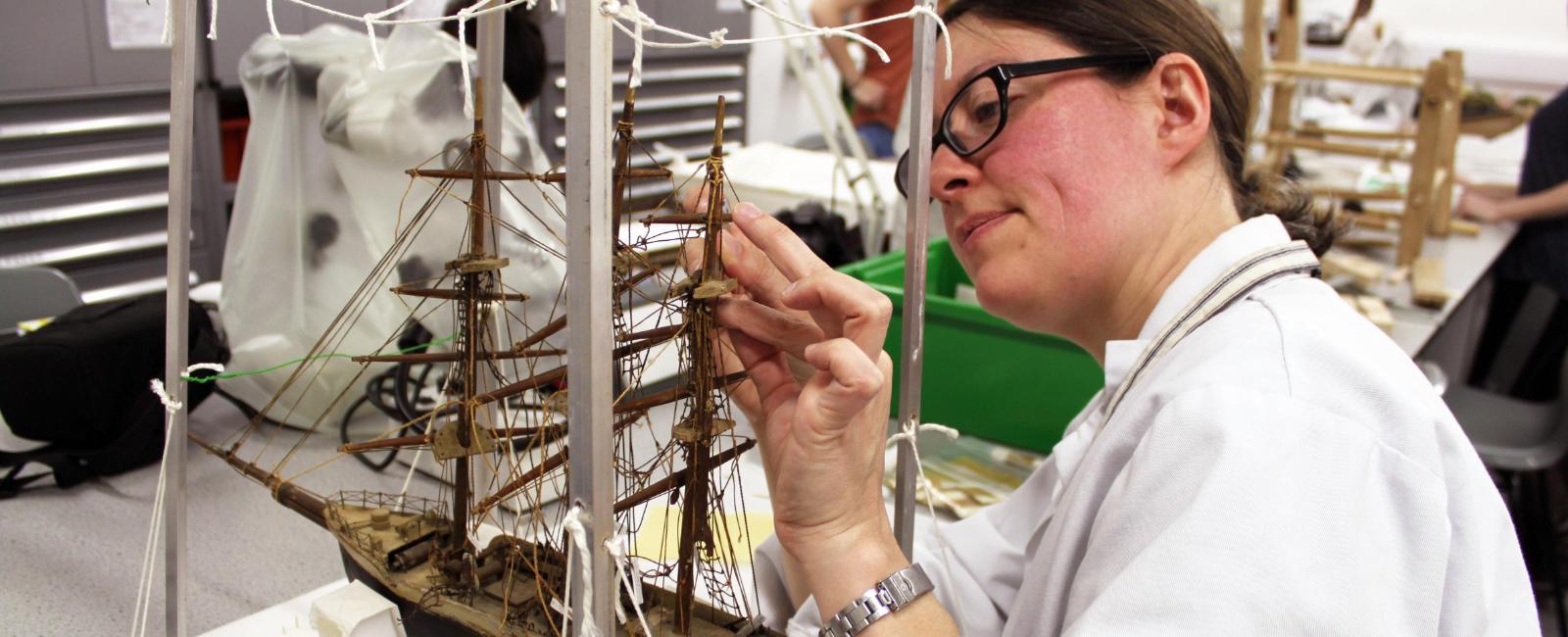
This is a practical module covering the conservation treatment of one or more complex object of cultural heritage. Exact content will depend on object type chosen. This module allows students to choose to specialise in a specific material discipline, or alternatively to pursue broader options.
Module Overview

This industry placement module provides students with immersive hands-on experience within a professional conservation setting, allowing them to apply and refine their practical skills. Through supervised workplace practice, students will develop advanced technical, professional, and reflective skills that support their transition into the conservation profession. Students are responsible for negotiating the placement arrangement.

Module Overview

This term 2 industry placement module provides students with immersive hands-on experience within a professional conservation setting, allowing them to apply and refine their practical skills. Through supervised workplace practice, students will develop advanced technical, professional, and reflective skills that support their transition into the conservation profession. Students are responsible for negotiating the placement arrangement.

Module Overview

This is a practical module covering the conservation treatment of one or more complex object(s) of cultural heritage. Exact content will depend on object type chosen. This module allows students to choose to specialise in a specific material discipline, or alternatively to pursue broader options.


† Some courses may offer optional modules. The availability of optional modules may vary from year to year and will be subject to minimum student numbers being achieved. This means that the availability of specific optional modules cannot be guaranteed. Optional module selection may also be affected by staff availability.

What You Need to Know

We want you to have all the information you need to make an informed decision on where and what you want to study. In addition to the information provided on this course page, our What You Need to Know page offers explanations on key topics including programme validation/revalidation, additional costs, and contact hours.

How you are assessed

Students are assessed through a diverse range of methods, including presentations, essays, technical reports, group work, practical activities, portfolio development, digital resources, or research. This facilitates a balance between theoretical grounding and practical experience of real-world tasks. Assessments thus address a range of employability skills, including those technical skills necessary for professional practice in the conservation sector, and transferable skills such as teamwork, communication, problem solving, digital literacy, reflection, and critical thinking. Second-year students studying as blended learners are required to submit a short monthly report to monitor their progress on the practical modules. Online tutorials are offered by the module tutor to support this. The University of Lincoln's policy on assessment feedback aims to ensure that academics will return in-course assessments to students promptly, and usually within 15 working days of the submission date. To obtain the Masters degree, students must submit a 15,000-word dissertation.

Lincoln Conservation

The University is home to Lincoln Conservation, a company that combines research, teaching, and commercial expertise. It specialises in architectural paint research and the digital and physical conservation of historic objects, decorative schemes, and buildings. The expertise of our consultants has helped to inform the restoration of the Midland Grand Hotel (now known as the St Pancras Renaissance Hotel), HMS Victory, and Southwell Minster.

A student being instructed while working at height on a conservation project at Lamport Hall

Our Facilities

Gain hands-on experience in our high-specification laboratories working on a range of historic materials provided by museums, historic houses, and private collections.

Career Development

Postgraduate study is an investment in yourself and your future. It can help you to further or completely change your career, develop your knowledge, enhance your salary, or prepare you to start your own business. Graduates have gained employment as conservators in museums, galleries, historic houses, and conservation agencies, both nationally and internationally. Internships have included roles in natural history at the Horniman Museum, mechanical objects at Edinburgh Museum, and textile or decorative arts conservation with the National Trust’s two prestigious conservation studios.

Placements

In the second year of the programme, students will have the option to complete two practical conservation modules as blended learners – fulfilling the module learning outcomes and assessments with an employer or placement host. In the past, students have completed placements with a range of conservation organisations, including but not limited to private conservation studios, museums, and galleries. 

Entry Requirements 2026-27

Entry Requirements

First or second class honours degree in any discipline or equivalent professional experience for UK applicants. For international applicants, equivalent qualifications or professional experience.

Non UK Qualifications:

If you have studied outside of the UK, and are unsure whether your qualification meets the above requirements, please visit our country pages

https://www.lincoln.ac.uk/studywithus/internationalstudents/entryrequirementsandyourcountry/ for information on equivalent qualifications.

EU and Overseas students will be required to demonstrate English language proficiency equivalent to IELTS 6.0 overall, with a minimum of 5.5 in each element. For information regarding other English language qualifications we accept, please visit the English Requirements page

https://www.lincoln.ac.uk/studywithus/internationalstudents/englishlanguagerequirementsandsupport/englishlanguagerequirements/

If you do not meet the above IELTS requirements, you may be able to take part in one of our Pre-sessional English and Academic Study Skills courses.

https://www.lincoln.ac.uk/studywithus/internationalstudents/englishlanguagerequirementsandsupport/pre-sessionalenglishandacademicstudyskills/

If you would like further information about entry requirements, or would like to discuss whether the qualifications you are currently studying are acceptable, please contact the Admissions team on 01522 886097, or email admissions@lincoln.ac.uk

Please note application assessment criteria may vary by country and we may close to applications from some domiciles. Please view the Your Country pages of our website before making an application.

Course Fees

You will need to have funding in place for your studies before you arrive at the University. Our fees vary depending on the course, mode of study, and whether you are a UK or international student. You can view the breakdown of fees for this programme below.

Course Fees

The University offers a range of merit-based, subject-specific, and country-focused scholarships for UK and international students. To help support students from outside of the UK, we offer a number of international scholarships which range from £1,000 up to the value of 50 per cent of tuition fees. For full details and information about eligibility, visit our scholarships and bursaries pages.

Academic Contacts

For more information about this course, please contact the Programme Leaders.

Leah Warriner-Wood
LWarrinerWood@lincoln.ac.uk

Melina Smirniou
MSmirniou@lincoln.ac.uk

The University intends to provide its courses as outlined in these pages, although the University may make changes in accordance with the Student Admissions Terms and Conditions.