
BSc (Hons)
Occupational Therapy
Key Information
Campus
Brayford Pool
Typical Offer
Duration
3 years
Validation Status
UCAS Code
B920
Academic Year
Occupational Therapy helps people of all ages take part in the activities that matter to them, from getting dressed and preparing meals, to working, studying, and enjoying hobbies. Occupational therapists support people experiencing physical, mental, or social challenges, helping them live more independently and participate fully in everyday life.
On this course, you'll explore how health, wellbeing, and the environment affect people's ability to carry out daily activities. You'll develop skills in assessment, rehabilitation, communication, and person-centred care through practical teaching, simulated learning, and professional placements.
You will also learn alongside students from other health professions, preparing you for collaborative working across healthcare, social care, education, and community services.
Why study Occupational Therapy at Lincoln?
Work towards a professional career
Develop the knowledge, practical skills, and professional behaviours needed to become an occupational therapist.
Gain real-world experience
Apply your learning through professional placements and simulated practice across healthcare, social care, community, and other settings.
Learn alongside other healthcare students
Develop teamwork and communication skills through shared learning with students from different health and care professions.
Explore diverse career opportunities
Discover how occupational therapists support people across mental health services, rehabilitation, education, social care, and community settings.
Develop skills for modern practice
Explore assistive technologies, digital healthcare, evidence-informed practice, and approaches to improving services.
Study with a Foundation Year option
An integrated Foundation Year pathway offers additional academic preparation before progressing into the professional degree.
Build confidence throughout your studies
Develop your knowledge progressively through practical workshops, case studies, simulation, and supported placements.
Specialist healthcare learning facilities
You'll benefit from teaching, clinical skills, and simulation facilities within the Sarah Swift Building. These spaces will support practical learning and help you develop confidence before entering professional environments.
Connect with regional healthcare providers
The School works with NHS organisations, local authorities, independent providers, and voluntary sector partners. These relationships help inform teaching, practice learning, and professional development.
What you'll learn
Occupational therapy combines an understanding of health, human behaviour, and everyday activities, with practical approaches to improving independence and wellbeing.
Throughout your degree, you'll learn how to assess people's needs, identify barriers to participation, and develop appropriate support plans. Your studies will focus on applying knowledge to realistic situations, preparing you for professional practice.
You'll explore how to:
- Understand people and their needs
Examine how physical health, mental wellbeing, human development, and social circumstances influence everyday activities. - Assess and plan support
Develop skills in identifying challenges, setting goals, planning interventions, and evaluating outcomes.
- Promote independence and inclusion
Explore how occupational therapy helps people overcome barriers and participate in activities that matter to them. - Apply evidence to practice
Use research, professional reasoning, and critical thinking to make informed decisions. - Work collaboratively
Develop communication, teamwork, and professional skills for working with individuals, families, carers, and multidisciplinary teams. - Use technology to support care
Explore assistive technologies, digital healthcare, and technology-enabled approaches to supporting independence. - Respond to complex needs
Consider how occupational therapy supports people across different ages, conditions, and care environments.
Support and student experience
Studying for a healthcare profession involves developing academic knowledge, practical skills, and professional confidence. At Lincoln, your learning is designed to progress gradually, helping you prepare for increasingly complex situations.
You'll benefit from:
- Supportive practical learning
- Placement preparation and support
- Constructive feedback
- Varied assessment methods
- Inclusive learning approaches
- Career-focused development
The course is designed to help you become an independent learner and confident future practitioner, with opportunities to apply your knowledge throughout your studies.
Careers and future opportunities
Occupational therapists help people of all ages overcome challenges, maintain independence, and participate in everyday life. Their skills are valued across healthcare, social care, education, and community services.
BSc (Hons) Occupational Therapy at Lincoln is designed to prepare you to apply for registration with the Health and Care Professions Council (HCPC), subject to successful completion and applicable regulatory requirements.
Following professional registration, you could pursue occupational therapy roles in:
- NHS hospitals and rehabilitation services
- Mental health services
- Community healthcare
- Social care and local authorities
- Schools and education services
- Independent and voluntary organisations
As you gain professional experience, you could develop specialist expertise, progress into advanced practice, take on leadership responsibilities, or pursue postgraduate study and research.
Your degree will also develop transferable skills in communication, problem-solving, teamwork, and decision-making.
Placements and work experience
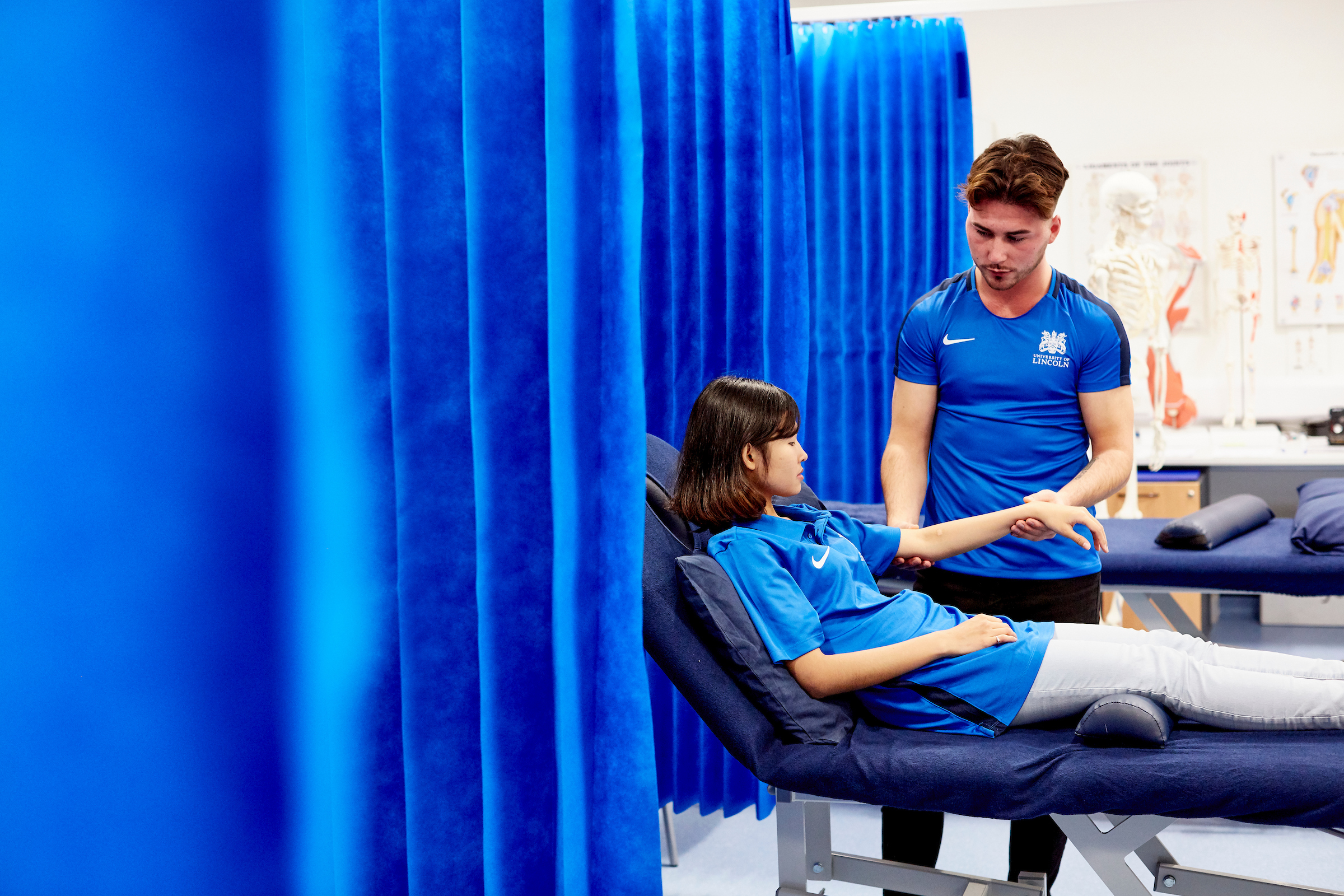
Practical experience is central to your degree. You'll combine classroom learning with simulation and professional placements, helping you connect theory with the realities of occupational therapy.
Placements are planned across settings such as healthcare services, community rehabilitation, mental health, social care, education, and voluntary organisations.
Simulated practice will provide opportunities to develop assessment, communication, and decision-making skills in a supportive environment before and alongside placements.
Entry Requirements 2027-28
United Kingdom
112 to 120 UCAS Tariff points from a minimum of 2 A Levels or equivalent qualifications.
If you are eligible for a contextual offer, a one grade or 8 UCAS Tariff point reduction to the standard entry requirements will be applied.
A Level: BBB
BTEC Extended Diploma: DDM
T Level: Merit
Access to Higher Education Diploma: 120 UCAS points to be achieved from 45 Level 3 credits.
International Baccalaureate: 30 points overall.
GCSEs: Minimum of three at grade 4 or above including English and Maths or equivalent qualifications, such as Functional Skills Level 2.
The University accepts a wide range of qualifications as the basis for entry and do accept a combination of qualifications which may include A Levels, BTECs, Extended Project Qualification (EPQ).
In exceptional circumstances we may consider work experience alongside academic qualifications and will review this on an individual basis.
Certificates of all previous qualifications will need to be provided before any offers are confirmed.
Additional requirements:
- This course is not open to Overseas applicants.
- Successful performance at an interview.
- Understanding of written material and can communicate clearly and accurately in written and spoken English.
- Satisfactory completion of Occupational Health Check.
- Satisfactory completion of an Enhanced Disclosure from the Disclosure and Barring Service (DBS).
When you choose Occupational Therapy in your UCAS application, you will be asked an additional question regarding criminal convictions. Here you must declare all spent and unspent criminal convictions including (but not limited to) cautions, reprimands, final warnings, bind over orders or similar and details of any minor offences, fixed penalty notices, penalty notices for disorder, ASBOs or VOOs.
We are not accepting deferred applications for Occupational Therapy. You must apply in the year you wish to start the programme.
If your application is unsuccessful, you may be offered the option of changing your application to either the BSc in Nursing (Adult) or BSc Nursing (Mental Health). Any alternative offer would be subject to a successful interview (where an interview has not already taken place), spaces available and meeting the course entry requirements.
International
Non UK Qualifications:
- This course is not open to Overseas applicants.
- If you are now settled in the UK, and do not have GCSE English, you will require English Language IELTS 7.0 with no less than 6.5 in each element.
If you have studied outside of the UK, and are unsure whether your qualification meets the above requirements, please visit our country pages for information on equivalent qualifications.
https://www.lincoln.ac.uk/studywithus/internationalstudents/entryrequirementsandyourcountry/
For information regarding other English language qualifications we accept, please visit the English Requirements page.
https://www.lincoln.ac.uk/studywithus/internationalstudents/englishlanguagerequirements/
If you would like further information about entry requirements, or would like to discuss whether the qualifications you are currently studying are acceptable, please contact the Admissions team on 01522 886097, or email admissions@lincoln.ac.uk.
Contextual Offers
At Lincoln, we recognise that not everybody has had the same advice and support to help them get to higher education. Contextual offers are one of the ways we remove the barriers to higher education, ensuring that we have fair access for all students regardless of background and personal experiences. For more information, including eligibility criteria, visit our Offer Guide pages. If you are applying to a course that has any subject specific requirements, these will still need to be achieved as part of the standard entry criteria.Is this course right for you?
If you're interested in health and wellbeing, enjoy working with people, and want a career where you can make a practical difference, BSc (Hons) Occupational Therapy could be for you.
You may particularly enjoy this course if you're:
- Interested in understanding how people live, learn, work, and manage everyday activities.
- Motivated to help others overcome challenges and improve their independence.
- Curious about physical health, mental wellbeing, human behaviour, and rehabilitation.
- Comfortable working with people from different backgrounds and life experiences.
- Interested in a practical, people-focused career with opportunities across different services.
Fees and Funding
University Study is a major investment, so it’s important to understand the costs and support available. A full breakdown of the fees associated with this programme can be found below. Eligible students may be able to access scholarships and bursaries to help with study costs.