MA Medieval StudiesMA Medieval Studies |
Postgraduate Open Evening
If you are contemplating studying an MA or postgraduate diploma in History or Heritage at the University of Lincoln, learn about our programmes and meet the tutors at our open evening.
School Magazine
Open Days
Order a Prospectus
Virtual Open Day
Introduction
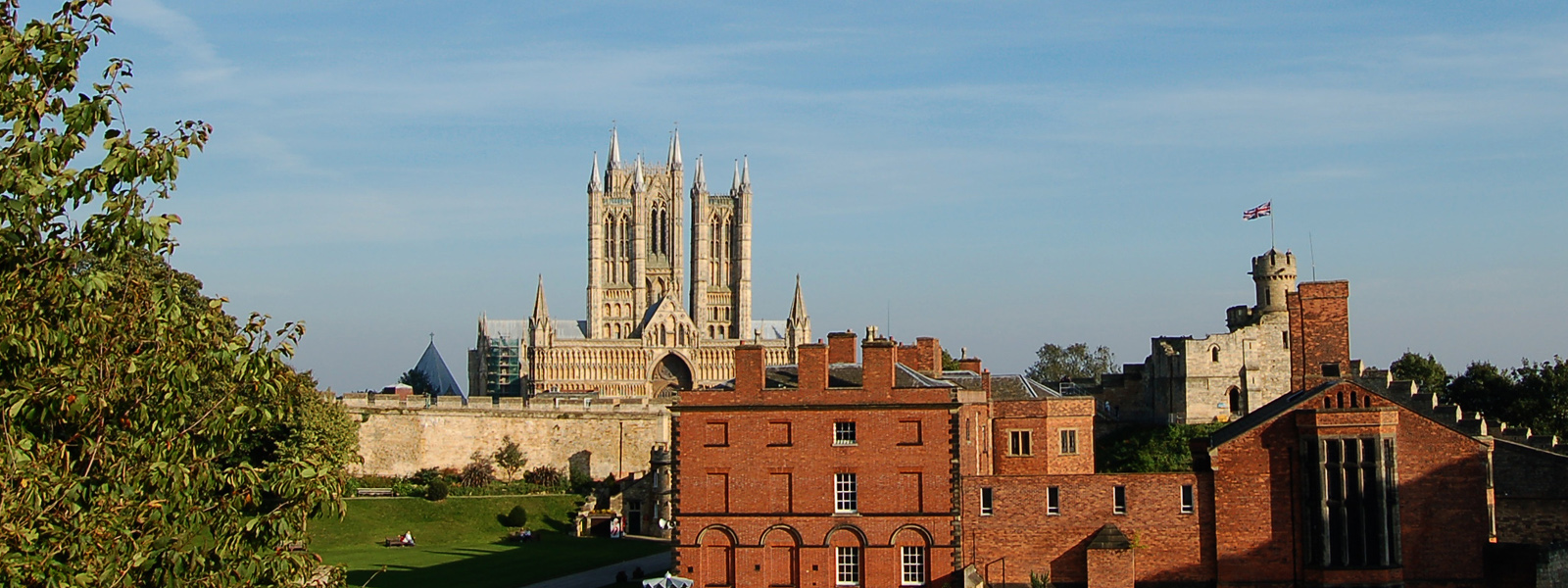
The city of Lincoln’s long and fascinating history, along with its remarkable range of medieval resources, makes it the ideal location in which to undertake an advanced study of the Middle Ages.
This MA in Medieval Studies will enable you to develop your skills for in-depth research and critical analysis of the historical sources available in Lincoln – home to one of four surviving original copies of the Magna Carta and to one of the finest medieval cathedrals in Europe.
You will learn skills such as palaeography and utilise historical archives to explore the economic, social and religious history of England. Modules in medieval literature and Arthurianism are supported by the wealth of literary manuscripts at Lincoln Cathedral, including one of only 50 full manuscripts of The Canterbury Tales and The Thornton Romances, containing the earliest known accounts of King Arthur’s death.
Days Taught
Tuesday and Thursday.
How You Study
Modules are taught in small groups in evening seminars of two hours.
In addition to the complete MA, students can choose to take a Postgraduate Certificate or Postgraduate Diploma.
The Postgraduate Certificate is made up of:
- Research Skills
Plus one option from:
- Priests and Parishioners
- The Once and Future King
- Telling Tales.
The Postgraduate diploma adds to the work of the certificate, including:
- Palaeography and Diplomatic
Plus one option from:
- Violence and Virgins
- Cosmos and Chronology
- Latin Language and Documents.
The complete MA is made up with the addition of a 15,000-20,000 word dissertation.
How You Are Assessed
Most modules are assessed through written work, usually essays or similar projects following the student’s own interests within the module. Palaeography and Latin are assessed by short exams.
Interviews & Applicant Days
There are no formal interviews but students interested in taking the course will be invited to have an informal conversation with the programme leader, if this is possible, or to have an email conversation.
Entry Requirements
Good honours degree in a relevant subject usually required.
International Students will require English Language at IELTS 6.0 with no less than 5.5 in each element, or equivalent. http://www.lincoln.ac.uk/englishrequirements
Key Contacts
Academic:
Dr Philippa Hoskin
phoskin@lincoln.ac.uk
01522 886340
Enquiries:
mhpenquiries@lincoln.ac.uk
+44 (0)1522 886097
Masters Level
Cosmos and Chronology (Option)
The predominant chronological device in the medieval world was dating by the year of an office, such as a king's reign. The medieval calendar included the annual commemorations of religious and civil events and changes in season, while the past was often organised into epochs, parallel realities, and myth histories drawn from a variety of ancient sources and remodelled to fit with the medieval world view. Medieval cartography, art and architecture made use of the same parallel realities and myth histories to create the rules and geometric conventions governing the depiction and design of physical space. This module uses current historical, cartographical, anthropological and art theories, considering documentary sources, images, buildings and the locality with a particular focus on Lincoln, to explore how changing conceptions of historical time and geographical space impacted on medieval perceptions of the present and its complex relation to the timeless past.
How the West was won: Bishops, barbarians and the transformation of the Roman world, 300-600 (Option)
This module addresses a pivotal moment in the transition from the ancient to the medieval world: the ‘fall’ of the Roman Empire in western Europe in the late fifth century. The module encourages students to conceptualise the end of Roman power in the West as a process that had its roots much further back in Roman history and that had long-term effects well beyond the late fifth century.
Intermediate Medieval Latin (Option)
All students on the MA course will receive some basic Latin training within their MA research methods module. For those students who already have some Latin, however, and for those who otherwise prove to learn quickly, this module will provide the opportunity to develop this essential skill for medievalists within a supportive context.
The course will provide students with the confidence to engage directly with the original sources.
Medieval Iberia: People, Power and Place (Option)
Few places in Europe experienced as culturally diverse and politically complex a medieval past as did the Iberian Peninsula. Indeed, as Janna Bianchini has pointed out, the study of medieval Spain and Portugal obliges us to confront ‘the rich and sometimes violent interchange of (at least) three cultures and religions.’ This module allows students to explore multiple aspects of the history of Spain and Portugal from 500 to 1300. This module is team taught, making use of Lincoln's unique research cluster in medieval Iberian studies, ensuring that students are at the forefront of the discipline.
Medieval Palaeography and Diplomatic
The module will provide an introduction to the practical techniques of reading medieval documents, including the use of standard abbreviation forms in documents, the use of standard phrasing in administrative documents, and the development of this practice in large administrations (including royal and ecclesiastical chanceries). This module introduces students to an essential skill for medievalists, that they may gain confidence and engage with medieval sources in their original form.
North by Northwest: Comparative Perspectives on Northern Europe from 750 to 1000 (Option)
This module looks at some of the major developments of medieval northern European history – developments that are too often studied in isolation. Frequently divided into either the Age of Charlemagne and his successors, or the period which saw the emergence of an English Kingdom (and perhaps, people), or an era of violence and trade given its primary impulse by Viking activity, the period from 750 to 1000 is best understood in all its complexity by means of a comparative approach. The module’s comparative framework will also provide crucial contextual knowledge for students looking to go on to PhD level; equipped with this knowledge, students will realise that no single interpretative paradigm of the period can do justice to the plethora of social, political, economic and cultural changes that took root in the period in question.
Playing fast and loose with history: Repackaging the past in medieval and modern culture (Option)
Everybody knows what ‘medieval’ suggests. And yet when more than one person’s idea of ‘what everybody knows’ is compared to another’s, very different notions of the ‘medieval’ emerge. For some, for example, it was a time of damsels and chivalrous knights. For others, it was a time of conspiracy – often engineered by machiavellian and corrupt churchmen – and political instability in which the ruthless could prevail. For others still, it was bloody, lawless, and violent – perhaps barbaric. This innovative module builds upon the respective research expertise of medieval and medievalism scholars – not least of those here at UoL – in order to develop an academic ‘conversation’ of this nature. Students will be therefore be immersed in an exciting scholarly exchange at its outset in which they will be expected to play their own part in outlining and contributing to the emerging scholarship.
Public and Private Emotions in the Middle Ages (Option)
How would you define emotions? This module will introduce students to some of the key issues posed by studying the history of emotions, particularly for the medieval period. This is a subject that has only recently attracted scholarly attention. A general introduction to the methodologies used in this field will be provided, focusing especially on how historians do or should approach texts that include emotions. Love, friendship, hatred and betrayal are some of the themes that will be discussed in the context of Western Europe and the Mediterranean between 1000 and 1400, a period when their meanings and values were sometimes astonishingly different from our modern conceptions. Primary sources consulted will include epistolary exchanges, philosophical and medical treaties, narrative and literary sources, ecclesiastical writings, as well as visual art and material culture, among others.
Reason and Rebellion (Option)
The English rebellion of 1258 to 1265 is usually given the adjective baronial: but the barons involved were not only the secular Lords. This module looks in particular at the bishops of Worcester, Chichester, Lincoln, London and Winchester in this period. In doing so it reveals the role of the thirteenth-century bishops within English Society and the important theological, philosophical and legal ideas of the day.
Research Methods
This module introduces students to a range of research methods used within medieval studies, and focuses on active engagement with the processes of gathering, evaluating and analysing data of various sorts. Students will also gain familiarity with, and be able to evaluate, different approaches to the analysis and interpretation of historical and literary data. The module will also introduce students to rudimentary Latin, both to give them some basic ability in an important language for medieval studies and to aid them in their palaeography work in the next core module.
Saints and Scholars: History and Hagiography in the Middle Ages (Option)
This module explores narratives concerning two central components of medieval communities’ self-perception and interactions with other communities: history and sanctity. Such narratives were for a long time dismissed by historians as inaccurate, biased, and of little scholarly value for any but scholars of literature. Recent decades, however, have seen fruitful research which considers the material through different lenses. This module allows students to explore the contention that there is no better way of understanding any culture than analysing how it imagines itself to have come into being and to be.
The end of the world as we know it: The chroniclers of barbarian history and the birth of the medieval order (Option)
Chronicles were without doubt the dominant form of historical writing throughout the medieval period. This research-based module will introduce students to these neglected sources, to their origins in the historiographical thought-world of the ancient and early Christian worlds, and to the key chronicle writers of the early Middle Ages.
Special Features
In celebration of the Magna Carta’s 800th anniversary world tour, the University of Lincoln is offering an international student a 20% scholarship for this MA. For more information, visit www.lincoln.ac.uk/course/medstdma
VISITING LECTURERS
The course makes use of visiting lecturers when possible. All students are invited to attend the University’s Annual Medieval Lecture, given by an academic of outstanding reputation. In addition, the School of History & Heritage’s visiting professor in Medieval History provides an annual seminar, lecture or masterclass for graduate students in Medieval Studies, as does the School’s annual international visiting fellow in Medieval History. Other visiting lecturers, from the UK, Europe and North America, have also given lectures and seminars for students.
Career and Personal Development
The critical understanding and extensive analytical skills that graduates
develop are particularly beneficial to careers in the heritage sector, museums and teaching. You may choose to progress your study at doctoral level.
Programme Specific Funding & Bursaries
In celebration of the Magna Carta’s 800th anniversary world tour, the University of Lincoln is offering an international student a 20% scholarship for this MA. For more information, visit www.lincoln.ac.uk/course/medstdma
Introduction
The city of Lincoln’s long and fascinating history, along with its remarkable range of medieval resources, makes it the ideal location in which to undertake an advanced study of the Middle Ages.
This MA in Medieval Studies will enable you to develop your skills for in-depth research and critical analysis of the historical sources available in Lincoln – home to one of four surviving original copies of the Magna Carta and to one of the finest medieval cathedrals in Europe.
You will learn skills such as palaeography and utilise historical archives to explore the economic, social and religious history of England. Some modules are supported by the wealth of literary manuscripts at Lincoln Cathedral, including one of only 50 full manuscripts of The Canterbury Tales, and The Thornton Romances, which contains the earliest known accounts of King Arthur’s death.
Days Taught
Wednesday and Thursday.
How You Study
Modules are taught in two-hour groups seminars.
In addition to the complete MA, students can choose to take a Postgraduate Certificate or Postgraduate Diploma.
The Postgraduate Certificate is made up of:
- Research Methods plus one optional module.
The Postgraduate diploma adds to the work of the certificate, and also includes:
- Palaeography and Diplomatic plus one optional module.
To obtain the MA students must submit a 15,000 to 20,000 word dissertation
>How You Are Assessed
Most modules are assessed through written work, usually essays or similar projects following the student’s own interests within the module. Palaeography and Latin are assessed by short exams.
Interviews & Applicant Days
There are no formal interviews but students interested in taking the course will be invited to have an informal conversation with the programme leader, if this is possible, or to have an email conversation.
Entry Requirements
A minimum 2:2 honours degree in a relevant subject.
International Students will require English Language at IELTS 6.0 with no less than 5.5 in each element, or equivalent. http://www.lincoln.ac.uk/englishrequirements
Key Contacts
Academic:
Dr Robert Portass
rportass@lincoln.ac.uk
+44 (0) 1522 837734
Enquiries:
mhpenquiries@lincoln.ac.uk
+44 (0)1522 886097
Masters Level
Cosmos and Chronology (Option)
The predominant chronological device in the medieval world was dating by the year of an office, such as a king's reign. The medieval calendar included the annual commemorations of religious and civil events and changes in season, while the past was often organised into epochs, parallel realities, and myth histories drawn from a variety of ancient sources and remodelled to fit with the medieval world view. Medieval cartography, art and architecture made use of the same parallel realities and myth histories to create the rules and geometric conventions governing the depiction and design of physical space. This module uses current historical, cartographical, anthropological and art theories, considering documentary sources, images, buildings and the locality with a particular focus on Lincoln, to explore how changing conceptions of historical time and geographical space impacted on medieval perceptions of the present and its complex relation to the timeless past.
How the West was won: Bishops, barbarians and the transformation of the Roman world, 300-600 (Option)
This module addresses a pivotal moment in the transition from the ancient to the medieval world: the ‘fall’ of the Roman Empire in western Europe in the late fifth century. The module encourages students to conceptualise the end of Roman power in the West as a process that had its roots much further back in Roman history and that had long-term effects well beyond the late fifth century.
Intermediate Medieval Latin (Option)
All students on the MA course will receive some basic Latin training within their MA research methods module. For those students who already have some Latin, however, and for those who otherwise prove to learn quickly, this module will provide the opportunity to develop this essential skill for medievalists within a supportive context.
The course will provide students with the confidence to engage directly with the original sources.
Medieval Iberia: People, Power and Place (Option)
Few places in Europe experienced as culturally diverse and politically complex a medieval past as did the Iberian Peninsula. Indeed, as Janna Bianchini has pointed out, the study of medieval Spain and Portugal obliges us to confront ‘the rich and sometimes violent interchange of (at least) three cultures and religions.’ This module allows students to explore multiple aspects of the history of Spain and Portugal from 500 to 1300. This module is team taught, making use of Lincoln's unique research cluster in medieval Iberian studies, ensuring that students are at the forefront of the discipline.
Medieval Palaeography and Diplomatic
The module will provide an introduction to the practical techniques of reading medieval documents, including the use of standard abbreviation forms in documents, the use of standard phrasing in administrative documents, and the development of this practice in large administrations (including royal and ecclesiastical chanceries). This module introduces students to an essential skill for medievalists, that they may gain confidence and engage with medieval sources in their original form.
North by Northwest: Comparative Perspectives on Northern Europe from 750 to 1000 (Option)
This module looks at some of the major developments of medieval northern European history – developments that are too often studied in isolation. Frequently divided into either the Age of Charlemagne and his successors, or the period which saw the emergence of an English Kingdom (and perhaps, people), or an era of violence and trade given its primary impulse by Viking activity, the period from 750 to 1000 is best understood in all its complexity by means of a comparative approach. The module’s comparative framework will also provide crucial contextual knowledge for students looking to go on to PhD level; equipped with this knowledge, students will realise that no single interpretative paradigm of the period can do justice to the plethora of social, political, economic and cultural changes that took root in the period in question.
Playing fast and loose with history: Repackaging the past in medieval and modern culture (Option)
Everybody knows what ‘medieval’ suggests. And yet when more than one person’s idea of ‘what everybody knows’ is compared to another’s, very different notions of the ‘medieval’ emerge. For some, for example, it was a time of damsels and chivalrous knights. For others, it was a time of conspiracy – often engineered by machiavellian and corrupt churchmen – and political instability in which the ruthless could prevail. For others still, it was bloody, lawless, and violent – perhaps barbaric. This innovative module builds upon the respective research expertise of medieval and medievalism scholars – not least of those here at UoL – in order to develop an academic ‘conversation’ of this nature. Students will be therefore be immersed in an exciting scholarly exchange at its outset in which they will be expected to play their own part in outlining and contributing to the emerging scholarship.
Public and Private Emotions in the Middle Ages (Option)
How would you define emotions? This module will introduce students to some of the key issues posed by studying the history of emotions, particularly for the medieval period. This is a subject that has only recently attracted scholarly attention. A general introduction to the methodologies used in this field will be provided, focusing especially on how historians do or should approach texts that include emotions. Love, friendship, hatred and betrayal are some of the themes that will be discussed in the context of Western Europe and the Mediterranean between 1000 and 1400, a period when their meanings and values were sometimes astonishingly different from our modern conceptions. Primary sources consulted will include epistolary exchanges, philosophical and medical treaties, narrative and literary sources, ecclesiastical writings, as well as visual art and material culture, among others.
Reason and Rebellion (Option)
The English rebellion of 1258 to 1265 is usually given the adjective baronial: but the barons involved were not only the secular Lords. This module looks in particular at the bishops of Worcester, Chichester, Lincoln, London and Winchester in this period. In doing so it reveals the role of the thirteenth-century bishops within English Society and the important theological, philosophical and legal ideas of the day.
Research Methods
This module introduces students to a range of research methods used within medieval studies, and focuses on active engagement with the processes of gathering, evaluating and analysing data of various sorts. Students will also gain familiarity with, and be able to evaluate, different approaches to the analysis and interpretation of historical and literary data. The module will also introduce students to rudimentary Latin, both to give them some basic ability in an important language for medieval studies and to aid them in their palaeography work in the next core module.
Saints and Scholars: History and Hagiography in the Middle Ages (Option)
This module explores narratives concerning two central components of medieval communities’ self-perception and interactions with other communities: history and sanctity. Such narratives were for a long time dismissed by historians as inaccurate, biased, and of little scholarly value for any but scholars of literature. Recent decades, however, have seen fruitful research which considers the material through different lenses. This module allows students to explore the contention that there is no better way of understanding any culture than analysing how it imagines itself to have come into being and to be.
The end of the world as we know it: The chroniclers of barbarian history and the birth of the medieval order (Option)
Chronicles were without doubt the dominant form of historical writing throughout the medieval period. This research-based module will introduce students to these neglected sources, to their origins in the historiographical thought-world of the ancient and early Christian worlds, and to the key chronicle writers of the early Middle Ages.
Special Features
In celebration of the Magna Carta’s 800th anniversary world tour, the University of Lincoln is offering an international student a 20% scholarship for this MA. For more information, visit www.lincoln.ac.uk/course/medstdma
VISITING LECTURERS
The course makes use of visiting lecturers when possible. All students are invited to attend the University’s Annual Medieval Lecture, given by an academic of outstanding reputation. In addition, the School of History & Heritage’s visiting professor in Medieval History provides an annual seminar, lecture or masterclass for graduate students in Medieval Studies, as does the School’s annual international visiting fellow in Medieval History. Other visiting lecturers, from the UK, Europe and North America, have also given lectures and seminars for students.
Career and Personal Development
The critical understanding and extensive analytical skills that graduates
develop are particularly beneficial to careers in the heritage sector, museums and teaching. You may choose to progress your study at doctoral level.
Programme Specific Funding & Bursaries
We are pleased to be able to offer up to three bursaries (scholarships), by competition, for those who wish to undertake one of the MA degree programmes offered by the School of History and Heritage (MA Conservation of Historic Objects, MA Historical Studies, MA Medieval Studies).
The bursaries will cover tuition fees up to £4970. There is no allocation per programme, and bursaries will be awarded to the candidates who submit the best applications. Students will be required to have applied for their MA programme of choice before submitting an application. Those who win a bursary who elect to take a programme over two years (2016-17, 2017-18) will receive half the bursary in each year, but the amount received will not rise in the second year (and so may not cover the full cost of tuition if fees rise in 2017-18).
Fees
| 2015/16 Entry* | 2016/17 Entry* | |
| Home/EU | £6,880 | £7,100 |
| Home/EU (including Alumni Scholarship** 30% reduction) |
£4,816 | £4,970 |
| Home/EU (including Non-Alumni Scholarship** 20% reduction) |
£5,504 | £5,680 |
| International | £12,961 | £13,700 |
| International (Including International Alumni / Global Postgraduate Scholarship** £2,000 reduction) |
£10,961 | £11,700 |
| Part-time Home/EU | £38 per credit point | £39 per credit point |
| Part-time International | £72 per credit point | £76 per credit point |
* Academic year September- July
** Subject to eligibility
Scholarships
As a postgraduate student you may be eligible for scholarships in addition to those shown above.
Guidance for Part-time Postgraduate Fees
To complete a standard Masters Taught programme, you must complete 180 credit points.
Full time students will be invoiced for the programme in full upon initial enrolment.
For part-time students, tuition fees are payable each credit point enrolled. To calculate your part-time fees, multiply the part-time fee per credit point by the number of credits you intend to complete within that academic year. This is usually between 60 and 90 credit points per year.
For example, if the fee per credit point for your programme is £38, and you enrol on 60 credits, the tuition fee payable for that academic year will be £2280.
For further information and for details about funding your study, scholarships and bursaries, please see our Postgraduate Fees & Funding pages [www.lincoln.ac.uk/home/studyatlincoln/postgraduateprogrammes/feesandfunding/].